An Istanbul earthquake alert has a local deadline
Evidence from the April 2025 earthquake separates phone-alert timing from later damage assessment. A warning interval depends on the location and shaking level measured.
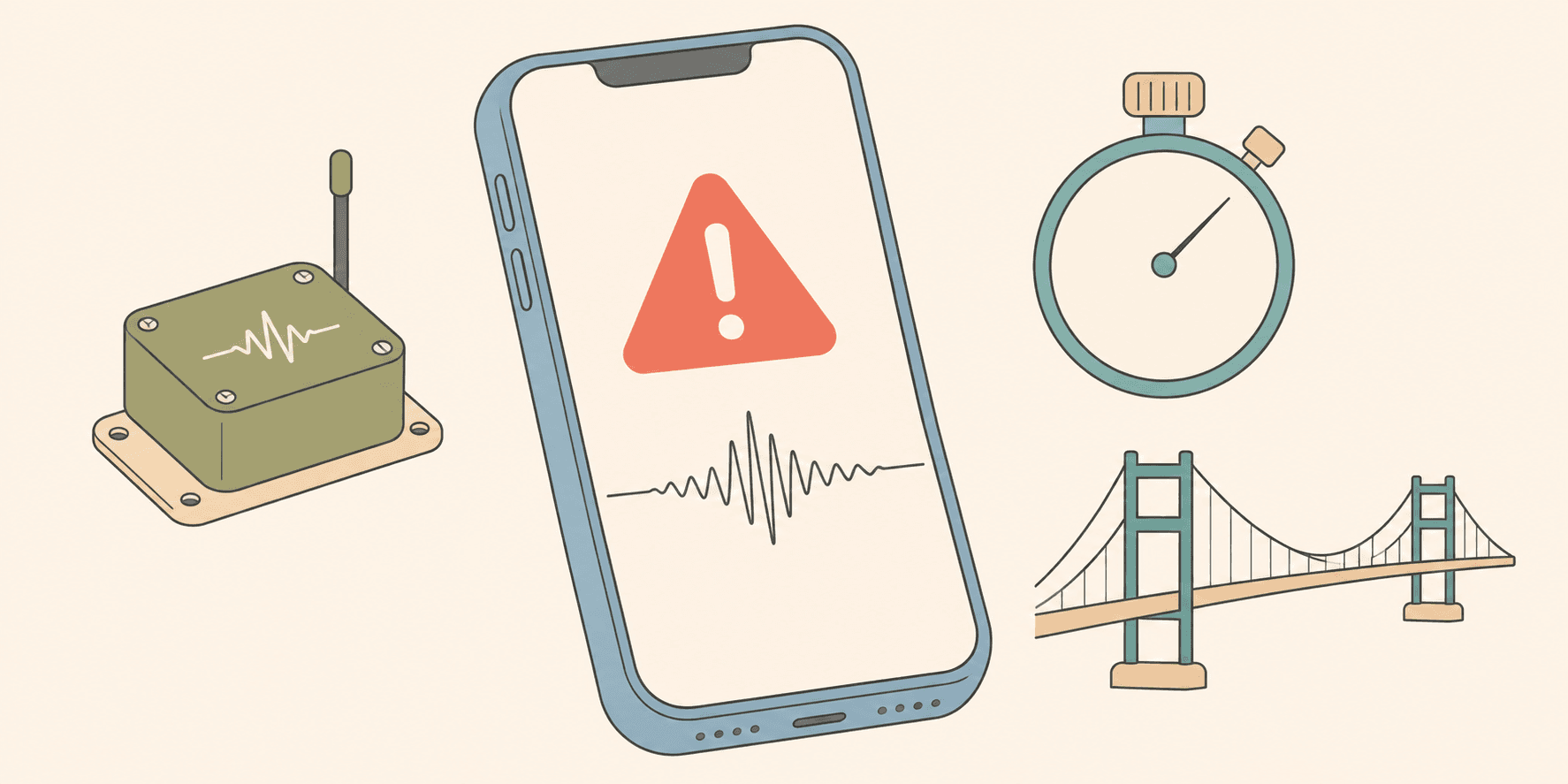
An earthquake alert has a deadline at the place where someone receives it. A fast detection time leaves the delivery time to be measured against the shaking at that location.
That makes a promise of a fixed number of warning seconds for Istanbul too broad. The source of a future earthquake will affect the time available. The alert also has to reach a particular device before its recipient can use it.
The April 23, 2025 earthquake provides evidence about systems that operated during one event. Reading that evidence means keeping each system's job separate.
Detection starts after the earthquake starts
Earthquake early warning uses observations of an earthquake already underway. Faster P waves can reach sensors before the later, potentially more damaging shaking reaches a more distant location. Electronic messages can travel ahead of that shaking. USGS explains how the detection process also creates a region near the source where useful advance warning may be impossible. USGS on the early-warning blind zone
The available interval depends on the event's geometry. It also depends on how soon the system can make a usable estimate. Waiting for more observations can improve an estimate while consuming part of the interval in which an alert could help.
An AI model can be evaluated for its contribution to that estimation step. A reduction in processing time leaves the remaining delivery process to be examined. The physical travel time of the shaking supplies the deadline against which the complete system operates.
For a performance report, the deadline needs a defined shaking level. The first weak motion at a site is one possible reference. The onset of stronger shaking is another. A number measured against one reference cannot silently become the result for the other.
The phone network has its own sequence
Google's July 2025 explanation of Android Earthquake Alerts describes using phone sensors to detect motion, with reports combined at its servers. The system estimates the earthquake before deciding where to issue alerts. Its account of the April 2025 Turkish event reports different warning times according to the shaking people experienced. Google's account of the phone-based system
A server issuing an alert records one event in that sequence. A phone displaying it records a later event. The difference between those times is part of the warning time available to that recipient.
This is why a city-wide count of alerts leaves a resident's experience unresolved. The count tells us how many messages were delivered within the reported scope. It needs location-specific timing before it can describe how much advance notice a particular neighborhood received.
A demonstration should therefore keep the starting time of the earthquake attached to its later timestamps. Calling every interval a response time makes it harder to determine which stage was measured.
The 2026 evaluation adds a narrower result
An August 2026 Nature Communications study examines Android alerts for the same Marmara event. It reports detection 5.31 seconds after earthquake initiation. Its headline warning-time statistics concern weak shaking, classified as MMI III, with shorter windows near the source. The paper also reports limitations in the area covered by stronger-action alerts because the estimated magnitude remained below the event's final magnitude. The August 2026 evaluation
Those results need their stated thresholds. A long interval before weak shaking at a distant location leaves the interval before stronger shaking nearby unanswered.
Google funded the evaluation. Its authors have Google affiliations, with two also holding academic appointments. The paper reports an evaluation of the company's own system; an independent assessment would provide a separate account of its performance.
The paper and Google's earlier blog also give different timing summaries. Keeping each result with its publication avoids constructing one apparently exact timeline from measurements reported under different descriptions.
Rapid response measures a later task
Boğaziçi University's report on April 23 describes the Istanbul Earthquake Rapid Response System processing recorded motion to produce shaking maps before estimating building damage. It says this work was completed within 90 minutes of the event. The report's damage estimates used a building inventory compiled in 2018. The university's April 28, 2025 report, pages 1 and 6
That system supports assessment after shaking has occurred. Its damage estimates depend on the inventory used in the calculation. Inspecting an individual building is a different task, requiring evidence about that building.
The same event can generate useful work at both timescales. Advance warning has a deadline measured before local shaking. A damage map can support a later response even though that warning deadline has passed.
A claim about a particular automatic shutoff needs a record from the system that performed it. That record would need to identify when the action finished. The rapid-response report supplies evidence for the maps it actually describes.
An enabled setting still has delivery conditions
Google's current Android help page includes Turkey among supported locations. Alerts can arrive before shaking starts. Delivery can also happen after the onset. The page notes possible errors in estimates, with some earthquakes going undetected. Android's current earthquake-alert documentation
For a user, the relevant check is the earthquake-alert setting on the actual phone, using the documentation for that device. Google's instructions also require Wi-Fi or mobile data to be on for alerts. A supported country establishes where the service operates. Reception in a future event remains conditional.
For an operator evaluating an automated protective action, the test needs to continue through the action itself. Receiving a message leaves the equipment's response time to be measured. The equipment must finish the intended operation while the available interval lasts.
Report that complete interval for the event and location tested. It gives a concrete account of what the warning achieved, without assigning Istanbul a countdown that a future earthquake may never provide.