What A-Lab's 2026 correction changed
The corrected A-Lab study separates successful synthesis from claims of scientific novelty. Product identification remains part of evaluating an automated experiment.
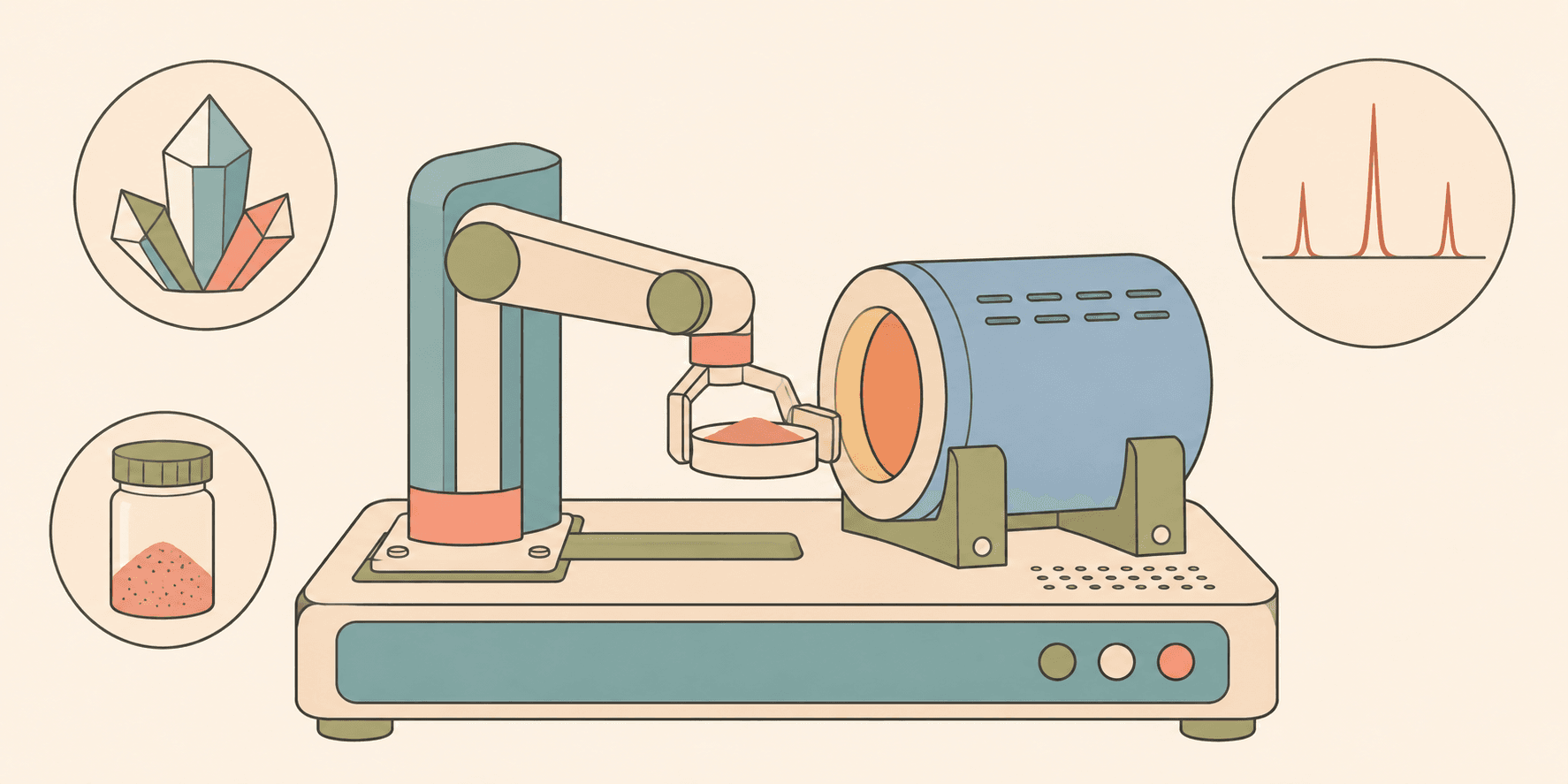
A robot can complete a synthesis while the identity of its product remains uncertain. That uncertainty belongs inside any claim about automated materials discovery.
The A-Lab paper makes this unusually concrete. Its January 2026 correction says manual reanalysis confirmed 36 of 40 reported successes, leaving four inconclusive from X-ray diffraction alone. It also clarifies that the intended novelty was relative to the prediction platform's knowledge. A material could already be known to science. The January 2026 correction
The result still concerns physical experiments. Its corrected scope changes what those experiments can be said to have established.
Follow the sample through the experiment
A-Lab's 2023 study describes automated solid-state synthesis of inorganic powders. Models propose recipes, with robots carrying out the preparation before heating the samples. X-ray diffraction supplies measurements used to interpret what formed. Results can feed back into the choice of a subsequent recipe. The corrected A-Lab study
That feedback gives the system a different job from generating a list of candidate structures. A recipe gets tested against physical material. The measured result then affects the next experiment.
It also creates a dependency. The decision about what to try next relies on an interpretation of what happened in the previous attempt. If that interpretation is wrong, a functioning robot can continue carrying out instructions that follow from a mistaken account of the sample.
An assessment of the laboratory therefore needs to follow that interpretation. A photograph of the equipment in operation shows that the equipment moved. The measurement attached to a particular sample carries the evidence for the claimed product.
Define the result being counted
The corrected study reports 36 compounds from 57 targets over 17 days. It counts synthesis of an ordered or partly disordered version of a target as success. Some successful samples also contained substantial byproducts. Those conditions belong beside the number when it is repeated. The study's experimental results
A count of successful targets leaves the amount of usable product to be specified. A sample containing the desired compound can still require further work before a device test. The purity needed for that test depends on the application being proposed.
Novelty requires another definition. A compound absent from the data used to plan an experiment gives the system something it has not previously been taught to make. Establishing that nobody has made it before requires examining the wider experimental record.
Those definitions can support different scientific objectives. Testing how a laboratory handles unfamiliar targets is an intelligible objective on its own. Reporting that objective accurately lets the experiment be assessed without adding an unsupported claim about first discovery.
Identification was the disputed step
In a 2024 perspective, Josh Leeman and colleagues examined the original A-Lab claims. They questioned automated interpretation of powder diffraction, with particular attention to disorder in crystal structures. Their criticism distinguished calculated structures with elements assigned to separate sites from experimental materials in which elements can share sites. That difference can change whether a proposed product is a new compound. Leeman and colleagues' analysis
This was a technical criticism of the reported interpretation. A faster robot would leave that criticism unresolved. The relevant response needs evidence about the sample's structure.
The 2026 correction reports a manually reviewed reanalysis that underwent post-publication peer review. That describes how the authors reassessed the results. It gives readers a revised claim to examine while keeping the original dispute identifiable.
There is a useful engineering lesson here. Automating a measurement can increase how often it is taken. It also increases the number of decisions that may depend on its interpretation. The review process needs a route for an ambiguous result, so uncertainty can remain visible when the system chooses its next action.
Read later work on its own terms
A September 2026 preprint from Rendy and colleagues reports using A-Lab to study sodium-ion-conducting solid electrolytes. Its abstract describes 78 trials yielding 18 promising compositions, with the search considering phase purity alongside conductivity. It is a preprint, so these are the authors' reported results before journal peer review. The September 2026 preprint
That is a different objective from demonstrating a count of newly identified compounds. A composition's measured behavior is being used to guide the search. Evaluating it requires knowing how that behavior was measured, with the sample preparation attached to the result.
The abstract leaves a manufacturing decision unfinished. Producing a material repeatedly at a specified scale would require evidence for that production process. A laboratory result can provide a reason to investigate it without supplying a factory's operating record.
The distinction also applies to the word autonomous. A report can identify the steps handled by the system, with the human work described separately. That makes it possible to understand what a second laboratory would actually need to reproduce the experiment.
Keep the evidence with the product claim
For a claimed synthesis, the record should let another researcher trace the product back to its recipe. The measurement used to identify that product needs to remain available for examination. An uncertain identification should travel with the result when it is summarized elsewhere.
For a proposed use, the next test needs to measure the property that use requires. A promising structure prediction gives a candidate for that experiment. A successful synthesis supplies material that can be examined. The claim about a usable component needs evidence from the component itself.
For a proposed battery component, conductivity would need to be measured under the conditions required for that component. That gives the laboratory a property to test once the sample has been identified.