Ten hours of ocean pumping leave a carbon claim unfinished
A Canary Islands pump reported substantial flow but operated for only about ten hours. Its engineering result and the carbon-removal question need separate measurements.
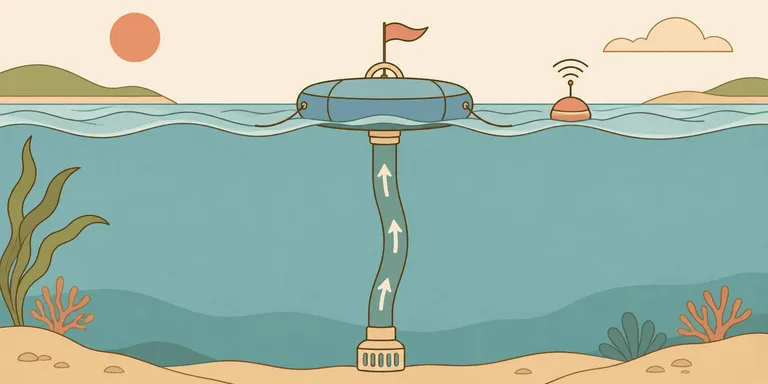
A wave-powered pump south of the Canary Islands brought water from 200 metres below the surface into sunlight. Its flow meters indicated about 3,000 cubic metres an hour. The result gave engineers a measurement to work with. The pump's short operating life left the planned biological investigation unfinished.
Those facts belong together. A carbon-removal proposal depends on what happens after water reaches the surface, including how much carbon returns to the atmosphere. The experiment begins with a flow measurement; the climate claim requires a much longer account.
The pump worked for roughly ten hours
GEOMAR's November 2022 account of the deployment describes a drifting buoy with a 200-metre hose, 1.9 metres wide. Waves moved the buoy, driving the upwelling. The reported location was about 140 nautical miles south of El Hierro.
The dimensions explain the physical test. Wave energy supplied the pumping motion, with no fuel-burning engine driving that motion. Deployment still required a vessel and equipment, so an assessment of the entire operation needs a wider accounting boundary.
GEOMAR's current project page adds the decisive operational limit: the pump functioned for approximately ten hours. That was too short for the intended monitoring program. A deployment planned around weeks of observation ended with a much shorter opportunity to study the water it had moved.
A useful engineering report therefore needs both the measured flow and the period over which the device operated. Extrapolating an hourly observation across a season would require evidence that the same device could survive and keep pumping throughout that season.
Water transport starts a biological process
Artificial upwelling brings nutrients from deeper water into the sunlit layer, where phytoplankton can use them. The intended carbon-removal mechanism depends on the resulting biological production and the later movement of carbon away from contact with the atmosphere.
Several transitions need measurement. The nutrients may support growth. Some biomass may be consumed near the surface. Some may sink, with carbon released again as organisms break it down. The location and timing of that release affect how long carbon stays out of atmospheric exchange.
A project can therefore measure increased production while still needing to determine its net carbon effect. Deep water contains dissolved carbon as well as nutrients. Bringing it upward changes the conditions controlling exchange with the air.
For an experiment, define the outcome before choosing the easiest sensor reading. A flow meter can measure water passing through the hose. Measuring carbon removal requires an account of the carbon that enters and leaves the affected system over the relevant period.
Earlier trials put duration beside flow
A 2010 open-ocean trial near Hawaii documented approximately 17 hours of wave-driven upwelling. Its reported rate was about 45 cubic metres an hour, with an estimated total input of 765 cubic metres. That was a different device in a different deployment.
The comparison is useful for its measurement structure. An operating period accompanies the rate. Multiplying those values gives the reported volume, while the biological response remains a separate part of the investigation.
For a later prototype, durability testing can address a defined engineering question: how long does it function under specified conditions? Preserve the failed intervals in the record. Counting only the periods with measurable flow can conceal the maintenance burden that a larger deployment would inherit.
A replacement design should also explain what changed after a failure. Recovering the device can provide evidence about the damaged part. Leaving a broken unit at sea would add a retrieval problem to the next experiment.
Recent modelling keeps the carbon balance open
A study published in October 2026 examined a different approach: counterflow Stommel pipes, which exchange heat between upward and downward flows. The authors used an Earth-system model with a high heat-exchange-efficiency assumption.
Their simulations produced regional differences. Large-scale deployment increased biological production while producing net ocean carbon release in parts of the simulated system. Some limited North Atlantic configurations produced carbon uptake. The authors also identified increased ocean deoxygenation as a side effect of greater export production.
These are model results for defined scenarios. Applying them to the Canary Islands wave pump would require an additional comparison of the designs and operating conditions. The model's limits also leave near-device mixing and maintenance outside what it can resolve.
The finding gives an experimental team a specific reason to measure the full carbon response. More biological growth can coexist with carbon release elsewhere in the process. Location belongs in the hypothesis before a project scales its result across a whole ocean basin.
Give a pilot a measurable purpose
Project Drawdown's assessment updated in February 2026 rates artificial upwelling as a climate solution it does not recommend. Its assessment questions effectiveness and feasibility. It also identifies environmental risks at scale. That is an assessment of deployment for climate mitigation, with a different decision from whether a bounded research experiment can answer a scientific question.
A proposed pilot should identify its question precisely. If the purpose is nutrient delivery to a seaweed farm, measure the farm's response over a stated period. If it is atmospheric carbon removal, specify the carbon-accounting method and the duration of storage the claim requires.
Publish the operating interruptions beside the environmental measurements. Make the baseline observations available so another team can inspect the comparison. After the next deployment, the useful result will include what the device did during the hours when the intended process stopped.