Predictable tides still need operating turbines
MeyGen's operating record includes electricity generation alongside turbine servicing. A tidal forecast helps planning, while the plant's availability determines how much of the resource it can use.
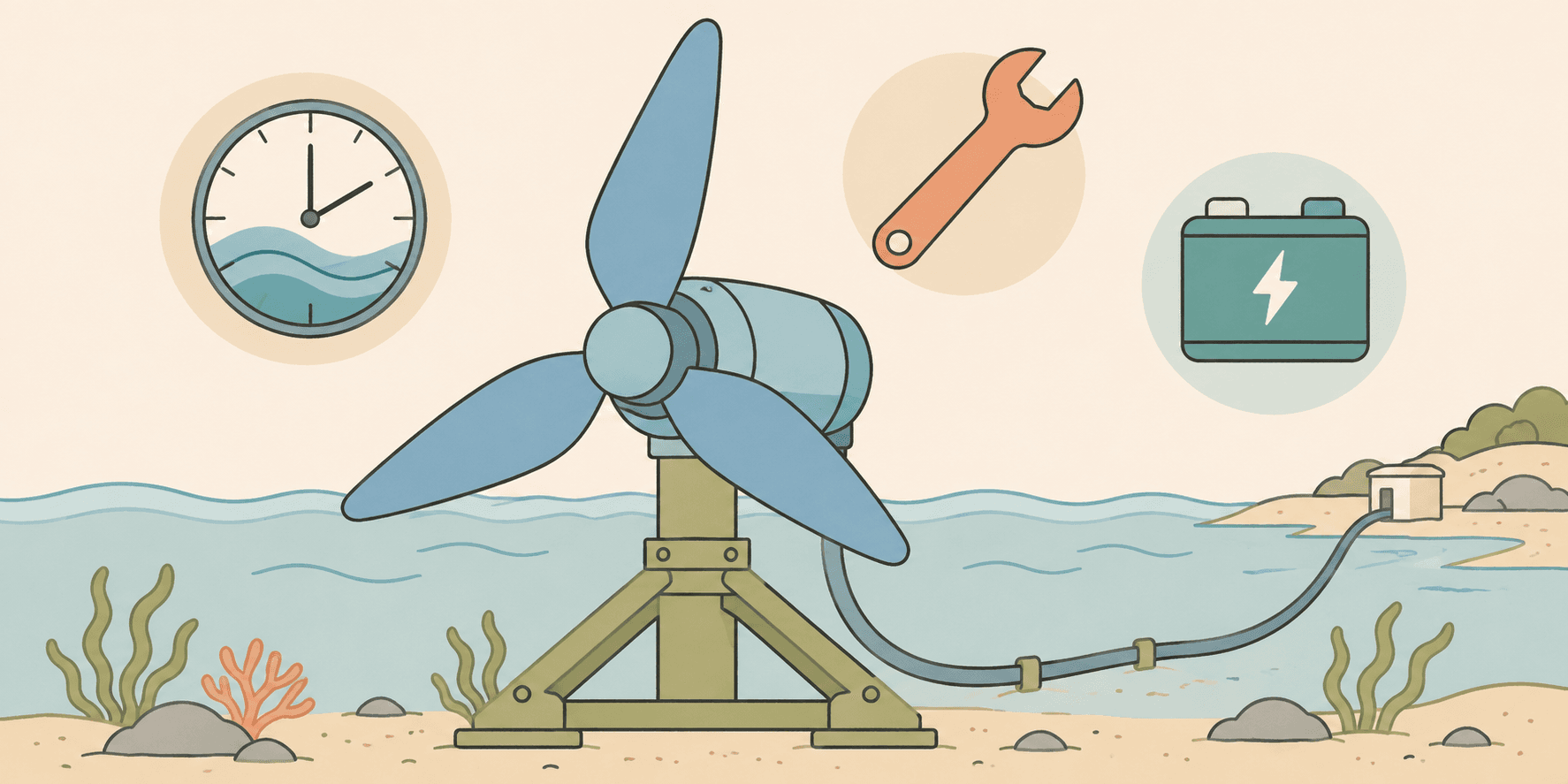
A forecast can tell an operator when the tide will turn while a turbine remains ashore for service. Generation still depends on the equipment being available.
Tidal energy has a predictable resource cycle. Delivering electricity over years also requires functioning machinery connected through cables to the grid. Maintenance access affects how much of that cycle the plant can use.
Scotland's MeyGen project has an operating record spanning years. Its reports let the installed-capacity figure be examined against electricity actually generated, with maintenance recorded alongside it.
Count the operating equipment
MeyGen's first phase has four 1.5-megawatt turbines, totaling six megawatts of installed capacity. The operator describes later phases separately, distinguishing support contracts from planning ambitions. Those stages define different amounts of equipment in service. The operator's project description
Consent allows a project to progress through one stage. A support contract supplies another commitment. Electricity enters the operating record after the relevant equipment is generating.
EMEC's January 2026 account describes an operating six-megawatt array. During a maintenance campaign, its team observed cable work followed by turbine recovery. The work also included maintenance before preparations for redeployment. EMEC's operational account
That account shows procedures required to keep the service running. The time spent recovering equipment belongs in the operating assessment beside the turbine's generating performance.
Read production with the servicing record
Ampeak Energy's September 2026 interim report says three turbines operated in the first half of the year while one remained ashore for service. Generation was 4.4 gigawatt-hours, compared with 7.9 in the first half of 2025. The operator attributes the reduction to servicing activity. The September 2026 report
Those values describe two six-month periods at one array. Estimating a long-term rate requires more operating history, with other projects evaluated against their own conditions.
The six-megawatt figure is a power rating. Gigawatt-hours measure energy produced over time. Equipment availability helps explain the energy delivered during a period, so its value needs more than the rating alone.
I'd inspect the installed equipment against the production record. When production differs from expectations, the account needs to explain why. Even a strong resource contributes no electricity through a turbine while that turbine is unavailable.
Plan for a variable cycle
Tidal-stream output changes through the cycle. Forecasting its timing helps planning, with the lower-output periods still requiring an account of how demand will be met.
EMEC's tidal-energy project used a battery to smooth output for an electrolyser, which uses electricity to produce hydrogen. The example combines predictable variable generation with storage to provide the input the electrolyser needs. EMEC's storage project
Define the service before assessing reliability. A contribution to a wider grid has different requirements from an isolated local load. Adding a battery creates another system whose delivered supply can be evaluated against that load.
Storage has a capacity limit with conversion losses. Its operating limits affect dispatch, while cost affects which design is viable. Predictable timing helps coordinate resources, leaving those design choices to be tested.
Include recovery in the plant design
An underwater turbine needs an inspection procedure. Recovery arrangements must cover repairs before return to service. The cable needs a maintenance account too, as does shore equipment.
EMEC's January account describes experienced teams performing offshore work. Their procedures depend on vessel availability with the required port facilities. Spare equipment affects recovery time, while organizing the operation determines when those resources can be used together.
A larger array might share maintenance resources across more turbines. It also adds equipment that can require work. Establishing a lower cost of electricity needs a comparison that accounts for both effects in the proposed operation.
An expansion therefore proposes a different system with a cost to test. The equipment count is one input; the test needs to follow service delivery through maintenance over time.
Specify the electricity demand
The Department of Energy distinguishes marine resources by their physical mechanism. Waves differ from tidal streams, while currents offer another resource. Temperature differences supply a further approach. A device demonstrated at one site provides evidence for its own operating conditions. Marine energy basics
A tidal proposal needs a suitable site with defined demand. Its expected production pattern should connect to a grid or local use. Maintenance arrangements belong in that account, followed by environmental evidence with the remaining uncertainty.
That description lets a reader assess where the project fits. A variable source can supply part of a system's demand when the complete design accounts for the periods it generates less.
MeyGen's record includes generation alongside servicing. Evaluating its next stage requires the same view of the operation over time, with the tidal cycle supplying the resource the equipment must remain available to use.