The Viral Modular Human Was an Art Project
OSCAR was science fiction. Real tissue chips earn their value by answering specific questions with carefully bounded evidence.
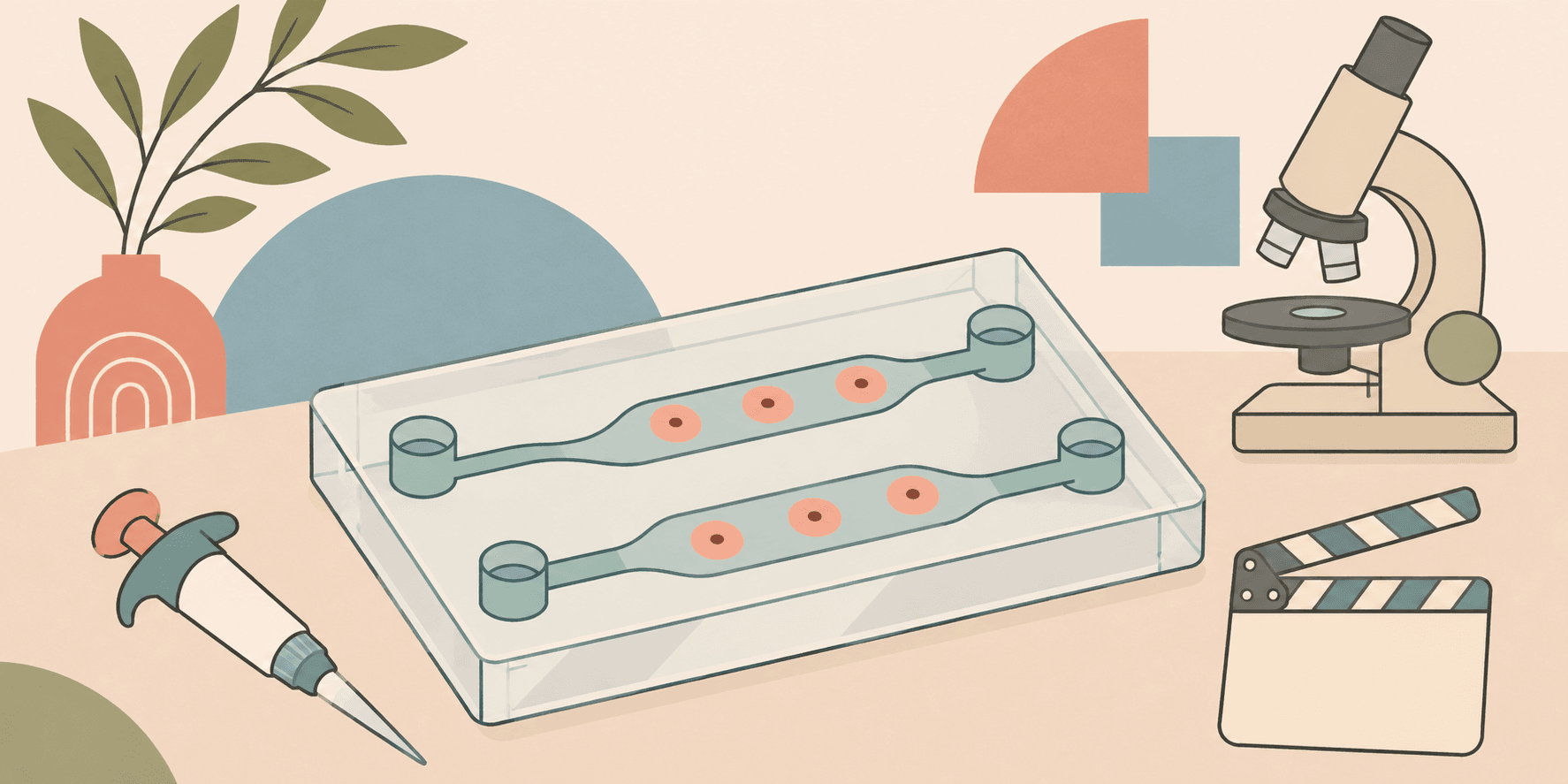
The creature called OSCAR was part of an art project. A video of it cannot tell us what a living laboratory model has been shown to do.
The Modular Body is Floris Kaayk's 2016 online science-fiction work. The IDFA archive identifies the project, its director, and its fictional biologist. That original context resolves the central question more directly than arguing over how realistic a detached clip looks. The festival archive
The real research nearby is interesting for a different reason. Scientists can build models of selected features of human tissue and ask focused questions with them. The value of a model depends on the question it can answer reliably, rather than how closely its appearance resembles a complete organism.
A tissue chip models a defined part of biology
The U.S. National Center for Advancing Translational Sciences describes tissue chips as engineered microsystems representing units of organs. They contain living cells and features intended to reproduce selected structures and functions. The goal includes improving predictions about the effects of drugs in people. The tissue-chip explanation
That is a specific scientific ambition. A model might help examine a tissue's response under controlled conditions. It does not become a complete person because its cells are human.
The chip's engineered environment is part of the experiment. Its arrangement, inputs, and measurements determine which aspects of biology it can represent. Calling it a miniature organ is convenient shorthand, but the shorthand should not replace that account.
This is also why a visual resemblance is not enough to assess usefulness. A model that looks less dramatic may provide a better measurement of the particular process a researcher needs to understand.
Decide what the model must predict
Consider a hypothetical drug-development study comparing how a tissue responds to a set of compounds. A useful model needs a defined output and a relevant comparison. The researchers must know what result would count as a correct prediction and which mistakes would matter.
That does not require the model to reproduce every feature of a body. It requires enough relevant biology for the intended question, with evidence that the measurement means what the team thinks it means.
The limits matter when a result travels. A response observed in one tissue model cannot silently become a claim about the complete human response to a medicine. Other tissues, exposures, and interactions may sit outside the experiment.
I would therefore read “human-relevant model” as an invitation to examine relevance. Which human process is represented? Which evidence supports the connection? Which part of the intended decision still requires another source of information?
Regulatory interest does not validate every device
The FDA's 2026 overview of new testing approaches describes work to reduce, replace, or refine animal testing using methods including cell-based systems, organ chips, and computational models. Its account of a September 2026 terminology rule explicitly says the change does not alter evidentiary standards or require a particular method. The FDA's current overview
That distinction is important. Recognition that a type of method can be relevant is not blanket validation of every platform using the label. Nor does an agency's roadmap demonstrate that one method can already replace every existing experiment.
The useful claim names the intended use and the supporting evidence. A platform might become valuable for one class of question while remaining unsuitable or insufficient for another.
There are commercial incentives to make that boundary look broader. A promising platform is easier to sell when its story moves quickly from a particular measurement to transforming drug development as a whole. The wider ambition may motivate research, but it should remain separate from the demonstrated result.
Repeatability makes the modest claim valuable
For a model to inform a consequential decision, another run needs to produce a result that can be interpreted consistently. Variation between preparations, batches, and experimental conditions needs an account.
This is not a demand that biology become perfectly uniform. It is a demand that the uncertainty be understood well enough for the proposed use. A measurement can be informative while having limits, provided those limits remain visible in the decision.
I would want to know whether the result depends on a particular preparation or analysis choice and whether the comparison includes examples the team did not use to develop the method. Those are ordinary questions about evidence, even when the equipment looks unfamiliar.
They also explain why a short laboratory clip is weak proof of clinical readiness. It can show an object or an activity. It rarely supplies the performance record needed to judge a predictive claim.
Ethical communication is part of the research
The International Society for Stem Cell Research's guidelines emphasize rigor, oversight, and transparency. Its 2025 update was targeted at stem-cell-based embryo models; it was not a universal announcement that every tissue model had crossed the same scientific or ethical threshold. The guidelines and update
The category matters. Tissue models, embryo models, and an artist's fictional organism should not be merged into one story simply because all involve images associated with biotechnology.
Clear communication lets the public ask a better question than whether the picture feels unsettling. What is this model, what was done with it, and what conclusion does the evidence support?
OSCAR works as fiction because it provokes a reaction. A laboratory model earns its scientific value through a different route: a defined question, a reproducible observation, and a carefully bounded claim. That quieter achievement is worth understanding on its own terms.