What Twenty-Five Million Kilos of Cleanup Actually Means
A cleanup total becomes useful when its material, location, period, and verification scope stay attached to the number.
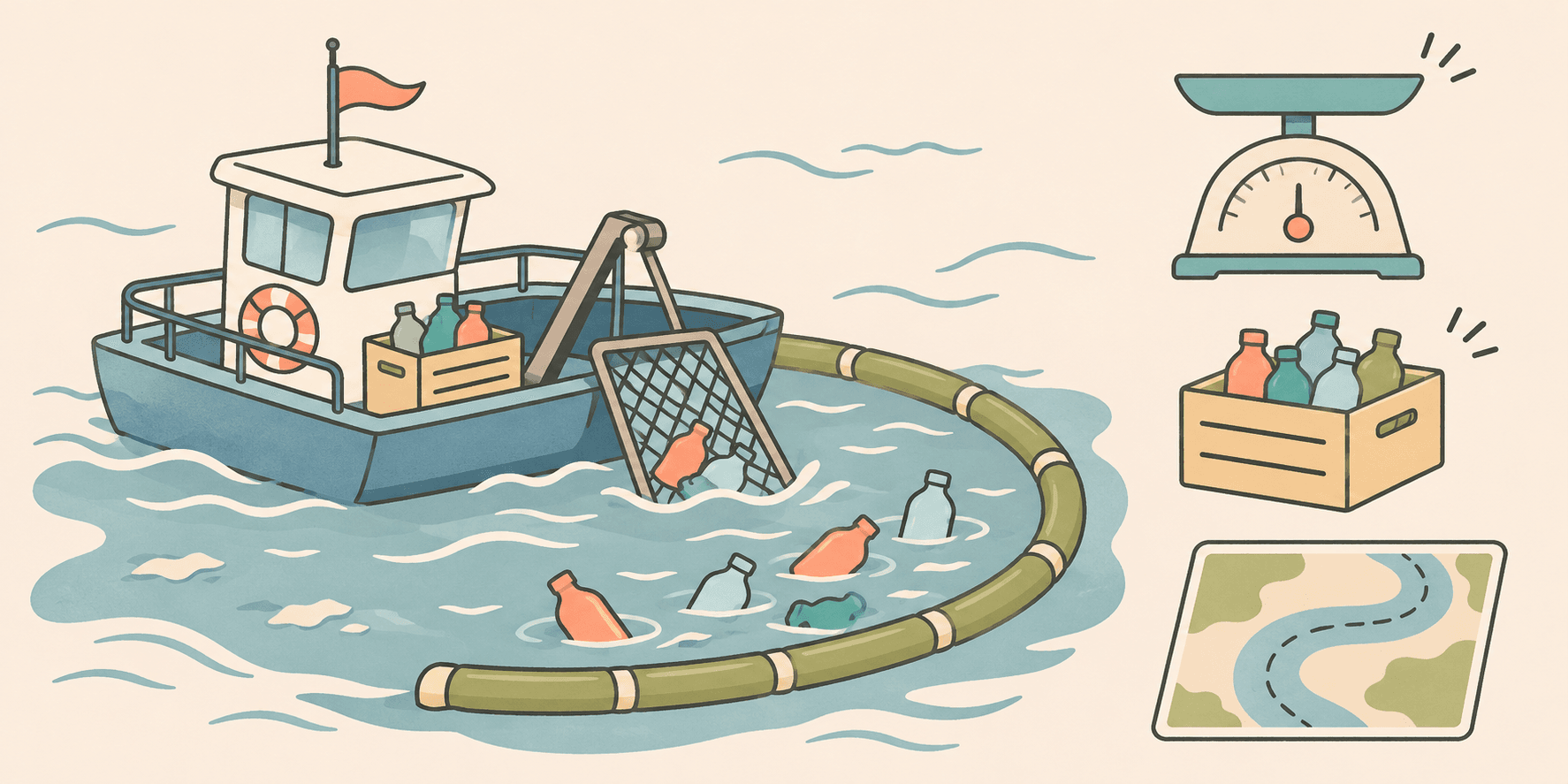
Twenty-five million kilograms sounds like a clear result. The next words determine what the result actually means.
In its December 2025 review, The Ocean Cleanup reported removing more than that amount of trash from aquatic environments. That is a substantial operational claim. It is also broader than “plastic removed from the open ocean,” a description that would silently change both the material and the place being counted. The organization's December update
Cleanup deserves an account that keeps the work visible without making the number carry every possible environmental claim. Collected weight, prevented pollution, traceable material, and ecological benefit are related outcomes. They need different evidence.
Keep the label attached to the total
A useful collection figure needs a period, a location, and a definition of the material. Is it plastic alone or mixed trash? Does it combine river interception with offshore collection? Is the figure annual or cumulative?
The December review is an organization-reported update. It should retain that attribution and date. It is not a live total for November 2026, and it should not be presented as an independent measurement of the entire ocean's improvement.
This does not make the work unimportant. It makes comparisons more honest. Two organizations can both report kilograms while counting different materials, locations, and operations. Adding their headlines together would not automatically create a comparable global measure.
I would want the measurement method available alongside an impressive total. That lets a reader understand what changed and lets another organization reproduce the accounting rather than merely compete for a larger number.
A future update should also explain whether its reporting method changed. Otherwise a larger total could reflect a wider collection boundary as well as more material recovered under comparable conditions.
River interception addresses a particular pathway
A 2021 study modeled plastic transport through rivers and estimated that more than a thousand rivers accounted for most modeled annual riverine emissions into the ocean. Its roughly 80% figure concerned that river pathway, not 80% of every source and form of marine plastic pollution. The study
The model used environmental and geographic information and was calibrated against observations. It is a useful way to identify where interventions might matter. It is not a direct weighing of every river, nor proof that installing equipment at a fixed list of locations will immediately stop the estimated flow.
Several authors were affiliated with The Ocean Cleanup. That does not erase the research, but it belongs in an account of the evidence and the organization's interest in interception technology.
The United Nations Environment Programme's river-pollution overview also emphasizes the uncertainty and differing scope of river estimates. It connects intervention with collection, prevention, and local conditions, rather than treating one modeled distribution as a complete solution. UNEP's overview
A traceability certificate answers a defined question
DNV's reclaimed-plastic standard describes verification of origin, authenticity, and the amount of reclaimed plastic in a product, following material through a chain of custody. The process covers stages such as extraction, landing, transport, and manufacturing. DNV's explanation
That is valuable evidence for the claim covered by the verification. It should not become a vague statement that “the numbers are audited” without identifying which quantities, operations, period, and claim were in scope.
The opposite shortcut would also be wrong: assuming a traceability standard never checks quantity. DNV explicitly includes amount among the things it can verify. The useful question is what a particular verification actually covered.
I would read the certificate's scope before using it to support a headline. Traceability of material in a product and a complete environmental-impact assessment are different jobs, even when both concern the same collected waste.
Weight is an observation, not the whole outcome
Imagine two hypothetical collection operations removing the same weight. One retrieves a concentrated accumulation of discarded equipment. Another collects mixed trash from a river. The identical total does not establish identical risks, effort, or environmental benefit.
The comparison would need to examine the material, the location, the work involved, and what happens afterward. It would also need to consider effects of the operation itself. None of those answers can be recovered from kilograms alone.
This is an argument for a richer account of success, rather than a reason to dismiss collection. A visible removal can be a real achievement while leaving questions about cost, avoided harm, and repeat pollution unresolved.
It also explains why source prevention and cleanup should not be treated as interchangeable credits. Catching an item after it enters a waterway and preventing the item from entering that pathway describe different interventions. Understanding their relationship needs a view of the surrounding waste system.
Follow the material after the photograph
The useful account continues after waste comes out of the water. It explains sorting, transport, and treatment, including what can actually be recovered. A photograph of collected bottles is an observation of one stage.
For a project promising a lasting reduction in pollution, I would also want to know how the incoming flow is changing. Repeated collection can show sustained work; by itself, it cannot show that the source of the problem has shrunk.
The most persuasive cleanup reporting keeps those outcomes separate and makes their connection inspectable. State what was collected, how it was measured, what happened to it, and which broader effects have evidence behind them.
There is good news in real material being removed from real places. Keep the label on the number, and the achievement becomes easier to understand, compare, and improve.