A spacesuit carries an atmosphere that its wearer can move in
A spacesuit must balance oxygen delivery with total pressure and mobility. The gas mixture is one part of a life-support system that also removes carbon dioxide and controls heat.
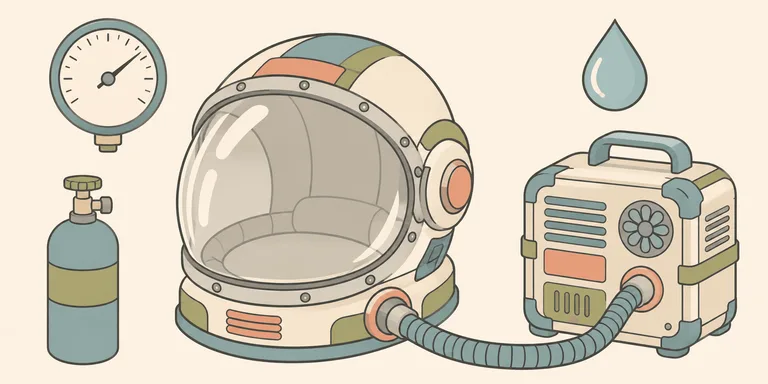
A spacesuit carries a controlled atmosphere around its wearer. Its pressure layer keeps that atmosphere contained, while its life-support equipment supplies breathing gas. The suit also has to let a person move. Increasing the pressure difference across a flexible suit makes movement harder, so the choice of pressure affects the work an astronaut can perform.
That choice is tied to the gas mixture. Knowing the oxygen percentage alone leaves out the total pressure of the gas being breathed. A suit designer has to consider both before deciding whether the atmosphere can support its wearer.
Oxygen percentage needs a pressure beside it
The International Space Station normally uses an atmosphere broadly similar to sea-level air. NASA describes a cabin pressure of about 14.7 pounds per square inch absolute, roughly 101 kilopascals, with oxygen near 21 percent. The rest of the mixture contains mostly nitrogen. NASA's oxygen-generation discussion explains that operating environment.
For a simple dry gas mixture, multiplying the oxygen fraction by total pressure gives its oxygen partial pressure. At the same percentage, a lower total pressure means a lower oxygen partial pressure. The physiology of breathing adds further conditions, which is why a percentage on its own is an incomplete description.
NASA's human-systems standard treats the inspired oxygen partial pressure as a controlled quantity. It specifies atmospheric requirements with exposure conditions, including requirements for carbon dioxide. These are separate variables within a habitable environment. The atmospheric requirements describe that system-level approach.
A cabin's total-pressure gauge therefore cannot tell the crew everything about its air. An atmosphere can remain pressurized while its composition changes. Monitoring the mixture is part of monitoring whether the enclosure remains habitable.
A suit has to permit work
The U.S. Extravehicular Mobility Unit operates at about 4.3 psi, approximately 30 kPa, using pure oxygen. That is one particular suit design. NASA's explanation of the pressure difference between the station and the EMU connects it to the preparation needed before a spacewalk. The explanation describes that operational relationship.
A lower-pressure suit reduces some of the mechanical resistance created by the pressure difference between its inside and outside. Its oxygen-rich atmosphere supports breathing at the selected pressure. The choice still involves the suit's physical structure, so a pressure number cannot describe the complete design.
The transition from a nitrogen-containing cabin atmosphere introduces another physiological issue. Decompression-sickness risk depends on the conditions before the pressure change as well as the conditions afterward. Oxygen prebreathe procedures are part of preparing for a particular transition. The procedure has to match the mission's validated plan.
That relationship explains why a headline about a new suit pressure needs context. A change can affect mobility while also changing the preparation associated with moving between systems. Evaluating the suit in isolation would leave out the environment from which its wearer entered it.
Keep the air usable after the hatch opens
Breathing consumes oxygen and produces carbon dioxide. A sealed enclosure needs a way to manage that continuing exchange. NASA's description of oxygen generation treats oxygen supply within the wider station life-support system, with air processing as an ongoing operation.
Heat adds another continuing load. The person inside a suit produces heat while working, and the surrounding thermal environment also affects the system. Suit life support has to handle that load during the planned activity. A supply bottle alone does not describe how long the complete system can support useful work.
Materials also affect which atmosphere a vehicle can use. NASA's 2026 work on surface-vehicle atmospheres discusses the interaction between flammability, ignition control, and human performance, with suit mobility among the linked design considerations. Some options remain subjects of analysis and testing. The technical-report record describes that current work.
Those dependencies give an atmosphere choice consequences outside breathing. Altering a gas mixture can change the materials problem. Altering a cabin pressure can change a suit transition. The complete design has to address the effects of the chosen combination.
Water on Mars has a different pressure problem
NASA's Mars fact sheet gives a reference surface pressure near 6.36 millibars, about 0.64 kPa, with variation across conditions. That is a small fraction of Earth's sea-level atmospheric pressure. The planetary fact sheet gives the reference value and its variability.
For pure water, the triple point lies near 0.01 degrees Celsius at roughly 6.12 millibars. Temperature and pressure together determine which phases can coexist in equilibrium. Local conditions and dissolved substances change the problem encountered by actual water on Mars. NASA's discussion of Martian water explains why a single boiling-temperature slogan is incomplete.
A phase diagram describes the behavior of a substance under specified conditions. A human body is a physiological system with tissues and circulating fluids. Applying the diagram of exposed pure water directly to every fluid in that body leaves those conditions unspecified. The useful engineering explanation starts with the atmosphere the life-support system must provide.
A workable suit combines that atmosphere with the ability to perform the mission's tasks. Its pressure setting has to fit its breathing-gas design, the transition from the vehicle, and the materials used around it. Those are joint constraints on one operating system.