Follow Samsung's solid-state battery from cell result to product evidence
Read the 2020 cell result in its own units, then check the 2026 samples and production target before accepting a vehicle-range claim.
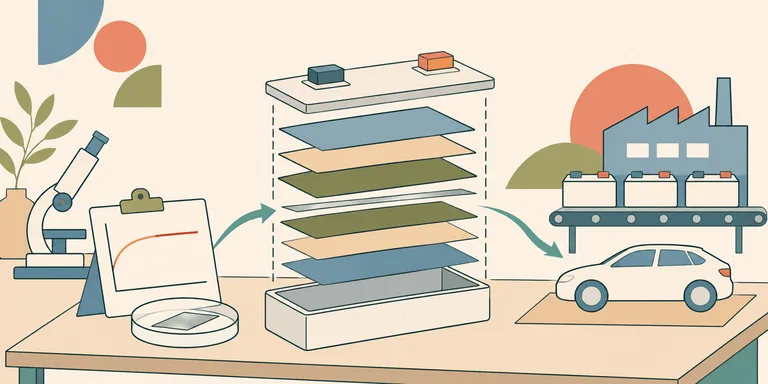
A thin silver-carbon layer was an important part of Samsung researchers' 2020 solid-state battery prototype. Understanding that result begins with the cell they tested. A claim about the driving range of a future car needs further evidence about a production pack and the vehicle using it.
There has also been development since that paper. As of November 14, 2026, Samsung SDI's public updates describe customer samples and a mass-production target. Keep those stages visible when reading a report that combines an older laboratory result with a new commercial timetable.
Read the prototype result in its own units
The Samsung Research record of the Nature Energy paper dates the publication to March 9, 2020. Its abstract describes a sulfide-electrolyte lithium-metal cell with a silver-carbon composite anode layer. The thin layer regulated lithium deposition in the researchers' reported design.
The reported prototype pouch cell had a capacity of 0.6 ampere-hours. The abstract gives volumetric energy density above 900 watt-hours per litre and a cycle-life result of one thousand cycles. Those specifications describe the research demonstration. Preserve the test conditions from the underlying paper when making a detailed engineering comparison.
Watt-hours per litre measures energy relative to volume. Watt-hours per kilogram measures energy relative to mass. A chart comparing battery technologies needs to identify which unit appears on each row. Mixing the two can make an apparent improvement meaningless even when each quoted number is accurate in its original context.
The silver-carbon layer belongs to a particular cell architecture. Its presence supplies no direct material-demand total for a future vehicle programme. That calculation would require the production design and the quantity of cells involved. A dramatic commodity forecast needs those inputs before the laboratory paper can support it.
Follow the current development stage
Samsung SDI's March 2026 InterBattery announcement states a target of mass production in the second half of 2027. It also describes expanding applications into physical AI, including robotics. Read that date as the company's announced plan and retain the publication date beside it.
The company's October 29, 2026 update says it shipped all-solid-state battery samples for humanoid robot applications while continuing customer evaluation and commercialisation preparations. That gives the reader a more recent status than the 2020 research result alone.
A sample shipment creates an opportunity for a customer to evaluate the technology. The eventual application has its own requirements. A robot and a passenger car place different demands on the battery system. Keep the stated application attached to the update instead of turning every solid-state milestone into a delivery promise for a particular car.
Ask what the production design must demonstrate
A manufacturer needs to produce cells consistently under the chosen process. The development programme has to establish how the design performs under the conditions required by its customer. Laboratory evidence can guide that work while leaving production performance to be measured through the programme's later stages.
For a vehicle application, ask for evidence about the assembled pack. The pack includes components beyond the active cell materials. Its usable energy and operating limits affect the vehicle result. A cell-level energy-density number therefore belongs beside a clear description of how the proposed pack uses it.
Cycle life also needs a stated measurement. Find the capacity-retention threshold and the charging conditions behind a reported cycle count. A result measured under one condition can be useful while another use requires a new test. Retain the conditions whenever the number becomes part of a purchasing or engineering comparison.
Connect range to the vehicle
Driving range depends on usable battery energy and the energy the vehicle consumes over distance. More usable energy can support a longer trip under comparable conditions. The size of the improvement requires those actual values. A material name leaves the necessary vehicle inputs unspecified.
The US government's electric-vehicle explanation describes the electric drivetrain and energy use. When assessing a future range claim, compare vehicles under an identified test method. A measured range under that method gives readers a firmer reference than combining unrelated cell and vehicle specifications.
A buyer deciding about a car available today needs the current vehicle's specifications and service terms. A research result can help them understand a possible future development. Keep the decision tied to the product that can actually be ordered, including its tested range and the charging conditions relevant to the buyer.
A useful comparison might hold the vehicle design constant and state how much usable pack energy changes. Another might hold range constant and examine a smaller pack. Those are different design choices with different consequences for the car. Ask which choice supports the announced result. Also retain the reference vehicle and the test conditions, because an improvement relative to an older baseline can sound larger when that baseline disappears from the headline. This is a way to organise the comparison before judging whether the claimed gain follows from the supplied specifications.
Look for the next piece of evidence
The next useful update could identify a production application or publish customer-validation results. Read it against the earlier development stage. Note which specification was demonstrated and which remains a target. This makes it possible to recognise progress without attaching an unmeasured outcome to it.
Samsung's silver-carbon research has a clear place in the technical record. Its current solid-state programme has a separate public development history. Reading both with their dates and units gives the reader enough context to judge the next announcement on the evidence it actually adds.