Give the agent and the workflow a shared completion record
OpenClaw and n8n can divide a task between interpretation and execution. Their handoff needs a durable job identity so retries do not repeat completed writes.
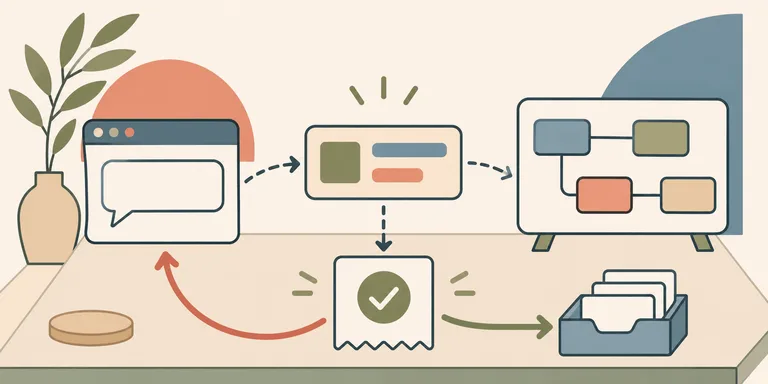
An assistant says it sent a request to a workflow. The workflow writes a record after receiving the request. It loses its connection before the reply arrives. The assistant cannot tell whether the write happened. Repeating the request may repair the interruption or create a duplicate.
This is the integration problem hidden by broad comparisons between OpenClaw and n8n. Either tool can participate in useful automation. A combined system still needs to define what crosses the handoff and how both sides recognize the same job after an interruption.
A chat interface can help a person express a task whose details need interpretation. A workflow can carry a defined operation through connected services. The division should follow the job, with the completion condition agreed before either component reports success.
Make the handoff a bounded request
Consider an assistant preparing an article draft for a CMS. The workflow receiving it needs a stable source identity and the fields to save. It does not need the assistant's whole conversation history. A narrower request makes validation easier and limits the information carried into the next system.
The receiver should check the fields it requires before attempting a write. If the source identity is missing, it can return a specific rejection. Letting a model improvise a substitute identifier during execution can make later retries look like new articles.
The operation also needs a stated scope. Saving a draft is different from publishing it. A workflow that accepts a draft request should not infer publication from a persuasive title or an instruction embedded inside the article text. The receiving contract should determine the action.
This division keeps the assistant useful where interpretation is needed while letting the receiving workflow enforce a concrete operation. It also makes a failure easier to locate: an invalid request needs different handling from a failed save. A verification failure needs its own investigation.
Read the response contract for the endpoint in use
n8n's Webhook node documentation describes response options that can reply immediately or after workflow execution, with a separate response node available for more control. An immediate acknowledgment cannot establish that every downstream action succeeded. The sender has to know which response mode the workflow uses.
OpenClaw's current inbound-hook documentation defines its own admission and completion behavior, including run identifiers and terminal records. Those details should be checked for the endpoint and installed version. A status code copied from an older example may have a different meaning from the current endpoint's documented response.
A completion record should state the accepted operation and its outcome. For the CMS example, it can identify the saved document and whether readback matched the requested fields. The assistant can then report that state accurately. A successful request transport is useful evidence about delivery, with the saved document providing evidence about the result.
If the operation is long-running, the sender needs a way to retrieve the final state. A job identifier can connect the initial acknowledgment to that later result. The retrieval path should survive the loss of the original chat connection so a person can investigate without asking the agent to start over.
Retrying should preserve the job's identity
Choose the identity before the first attempt and keep it across retries. The receiver can use it to find an existing result. If the request arrives twice, the second attempt should inspect the first operation's state before writing again.
A retry mechanism alone cannot provide this property. n8n's error-handling guidance explains error workflows and failure information. An operator still needs to determine which effects occurred before the error. A retry after a partially completed write needs different handling from a retry before any external action.
The destination's own API can help resolve uncertainty. If a source identity can be queried, inspect it after a timeout. Finding a matching document may allow the workflow to resume with verification. Creating another document immediately would turn an uncertain response into a confirmed duplicate.
The operation should also retain enough evidence for a person to intervene. A job record that names the failed stage and destination document gives an operator a useful starting point. An error message containing only the model's final sentence does not explain what the connected services actually did.
Test the interruption deliberately
Before relying on the integration, test a harmless operation with a response interruption after the destination write. Resend the same job and inspect the destination. The expected result is one logical document with a completion record that both components can resolve.
That test gives the architecture a concrete acceptance condition. OpenClaw's conversational behavior and n8n's workflow controls can be assessed within the same job, with the handoff responsible for preserving identity until the destination confirms the result.