Oklo is evidence for waste research, with limits a repository must respect
Read Oklo's ancient fission record as a natural analogue, and distinguish ONKALO's October 2026 licence from the start of operations.
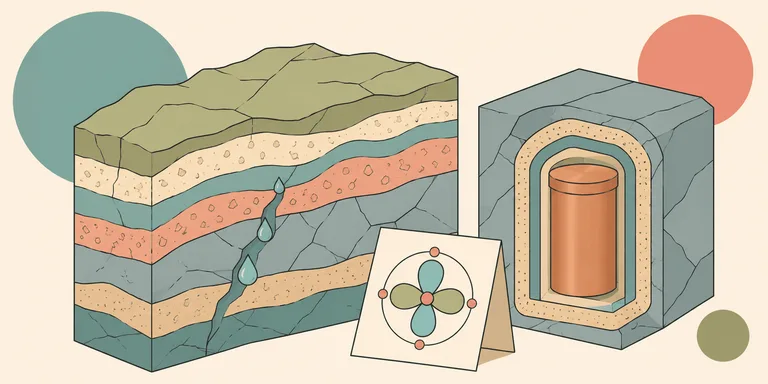
Oklo's natural reactors left evidence that fission products can remain in rock over geological time. That is an extraordinary observation. Using it to certify a modern waste repository would require a much larger inference.
The useful comparison asks which retention processes Oklo helps us understand, then checks whether those processes apply to the engineered site. Finland's ONKALO project has its own evidence and licensing requirements.
The ancient reactor left a measurable record
Researchers identified natural fission in uranium deposits in Gabon after observing unusual isotope proportions. The IAEA's account of the discovery describes how the ore and fission products pointed to reactions more than two billion years ago.
At that time, natural uranium contained a higher proportion of uranium-235. Water could moderate neutrons in the deposit, helping sustain a chain reaction under suitable conditions.
The evidence is physical material with an isotopic history. Scientists infer the ancient operating conditions from that record. Nobody observed a natural reactor switching on and off in real time.
A 2004 Physical Review Letters paper used noble-gas isotopes in material associated with the reactor to infer active pulses of about 30 minutes separated by dormant intervals of about 2.5 hours. That timing is a result from the analysed system.
It should not be assigned to every reactor zone as though all shared a perfectly synchronised schedule. The value lies in the evidence that supports the inferred cycle and what it reveals about the conditions at that location.
A natural analogue tests a part of the explanation
Oklo can inform questions about how elements move through minerals and groundwater. It offers a timescale that an ordinary laboratory experiment cannot reproduce.
A repository needs to account for its own waste form and surrounding chemistry. The container creates another set of conditions. A process that retains one element in an ore body may have a different effect on another element in a different host rock.
That makes an analogue useful when the comparison names a mechanism. "This mineral retained this material under these conditions" can inform a model. "Nature stored waste, so engineered disposal is safe" leaves the relevant differences unexamined.
The same caution applies to migration distances. Some retained fission products are evidence of retention in particular phases. Their presence does not establish that every radionuclide stayed in its original position for the site's entire history.
An assessment should preserve observations that limit the analogy as well as those that support it. Selective use of only the most reassuring element would make the comparison less informative.
ONKALO has passed a licensing milestone
The current Finnish status is more specific than an old prediction that disposal would begin in the mid-2020s. On October 22, 2026, the Finnish Government granted Posiva an operating licence for its encapsulation and final disposal facility, valid through 2070.
The government announcement also states that a STUK inspection is required before operation begins. The licence announcement alone therefore does not establish that spent fuel has already been emplaced.
Posiva's announcement of the decision describes the multi-barrier approach. Engineered barriers and the surrounding rock contribute different parts of the isolation system.
Keep the project milestone separate from the long-term safety argument. Permission to operate follows a regulatory assessment; continuing operations still require the relevant conditions to be met. A date on a licence is not the date of every subsequent operational step.
Ask what would invalidate the comparison
For an analogue, ask which change in water chemistry would alter retention. Ask whether the mineral phase being compared exists at the proposed site. For an engineered barrier, ask which failure modes the assessment includes.
Those questions make a discussion more demanding, but also more useful. They connect a striking geological fact to a specific engineering claim that can be examined.
Oklo remains evidence worth studying. The strongest use of that evidence preserves the conditions under which it was found. ONKALO must be evaluated through the conditions and barriers of its own site, with natural analogues contributing where the comparison holds.