The shape of a bone dagger can reveal what its maker preserved
A 2018 engineering study compared the structure of New Guinea daggers. Its findings deserve a more precise retelling than a claim that one kind of bone is always stronger.
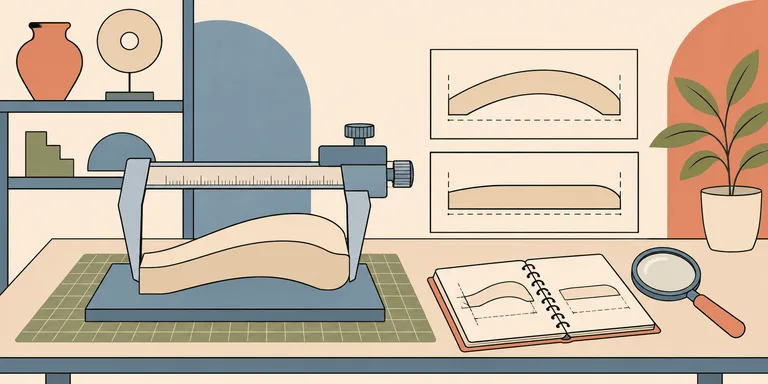
Calling an object stronger leaves out an essential condition: stronger under what kind of load? An artifact can resist bending in one direction while remaining vulnerable in another. Its shape contributes to that behavior, so the name of its material is only part of the explanation.
A 2018 study of New Guinea bone daggers makes this distinction worth examining. The Royal Society Open Science paper compared human-bone and cassowary-bone examples using computed tomography and finite-element analysis. The researchers examined 11 daggers, including ten museum objects. Their models supported greater resistance to the tested loads in the human-bone examples.
The authors linked that mechanical result to preserved cross-sectional curvature and proposed an interpretation involving the protection of social prestige. The result concerns the objects and conditions studied. It should not become a universal claim that human bone is a superior material for every object or purpose.
Read the object before generalizing about the material
A museum label can narrow the question. The Met's Kwanga dagger comes from the Middle Sepik River region of Papua New Guinea and dates to the late nineteenth or early twentieth century. Its medium is cassowary bone with pigment. This is a particular object with a recorded origin, not a generic illustration of every practice on the island.
The museum's explanation also notes that human-bone daggers could come from ancestors or enemies. The distinction prevents the reader from assuming that each example records the same social relationship. A material category cannot supply a biography for an individual artifact.
The Lam Museum's cassowary dagger has its own recorded context in Kuttim Village, East Sepik. Its explanation discusses ceremonial use alongside the objects' earlier use in conflict. That context gives a reader more information than treating a dagger only as an exotic weapon.
When two museum objects differ in shape, several explanations may be possible. A comparison needs to account for the specific objects being examined before attributing every difference to their material. Collection descriptions help establish what is known about those objects and where the record stops.
Separate a calculated result from an explanation of intent
An engineering model predicts a response under defined assumptions. To interpret the output, a reader needs to know what force was applied and how the object was constrained. A result under one loading arrangement cannot answer every question about historical use.
The same discipline applies when a model is used to explain a maker's decision. A shape that improves resistance to a tested load is consistent with a deliberate effort to reduce breakage. Determining why the maker chose it also requires cultural evidence. The mechanical result and the explanation of intention should retain their own supporting arguments.
This is not a reason to avoid interpretation. It is a way to make the interpretation assessable. A reader can accept a measured or modeled difference while examining the historical explanation separately. Combining the two into one unqualified sentence makes that examination harder.
The study's authors deposited supporting data in Dryad. A data record helps a later reader identify material behind the research. Reproduction still requires understanding the method and its assumptions; the existence of a downloadable file cannot substitute for that work.
Preserve the scale of the conclusion
A small comparison can answer a focused question well. It becomes less informative when retold as a verdict about a whole culture. The right scale depends on the sample and the evidence connecting the sampled objects to a broader practice.
For a short account of this study, keep the comparison explicit. Explain that geometry affects how an object bears a load. Attribute the proposed social explanation to the researchers. Keep the museum's information about individual objects beside any claim about their origin.
There is no need to turn the objects into a lesson that makes a present-day worker's difficult day seem trivial. Their history already contains a specific question: how did material choices and shaping relate to the value placed on an artifact? A careful account can leave that question intact.
When a headline says an artifact was engineered to be stronger, look for the loading condition and the explanation of intent separately. Those details let the research remain interesting without asking a single test to reconstruct an entire society.