A good Flow shot still has to survive the next cut
References and scene tools can help a generated sequence hold together. Review continuity, current feature limits, watermark rules, and the exported deliverable.
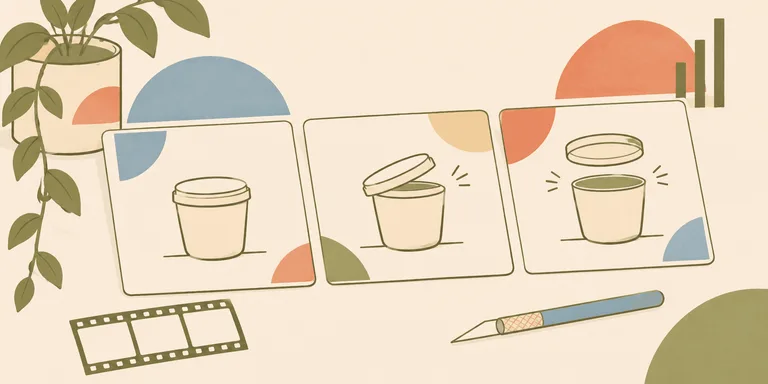
A generated shot can look convincing until the next shot arrives. The cup changes shape, the doorway moves, or an action resumes from the wrong position. A filmmaking tool becomes useful when the sequence survives the cut, not simply when one clip looks good in isolation.
Google Flow offers ways to create and arrange that material. The useful production question is which parts of a scene it can help you test, followed by what still needs inspection before the scene can be delivered.
Specify what must survive the cut
Write the scene's action before describing its visual style. A product sits on a table, its lid opens, and the camera moves closer. The table position, product shape, lid state, and movement direction are continuity requirements. "Cinematic" cannot supply them.
For each proposed shot, identify the information the viewer must receive. A wide shot can establish where an object is. A closer shot can reveal a mechanism. If both shots communicate the same thing, generating more variations may add selection work without improving the sequence.
Flow's current video-creation documentation supports prompts with ingredients and start or end frames. It recommends consistent references and avoiding conflicts between visual inputs and text. These controls provide ways to constrain a generation; they do not guarantee identical objects or correct motion across every output.
Keep a reference frame for the state that has to persist. Describe the transition separately from the object. A request to change the camera angle should not accidentally ask for a different room, time of day, or product design.
Build a sequence early
Flow's scene-building documentation describes arranging clips, trimming their ends, previewing a sequence, and downloading a scene. Saved frames can become references for later generations. That makes an early assembly possible before every shot has been polished.
Use that assembly to test whether the scene can be understood. A transition can fail even when both clips are attractive. An object may leave one side of the frame and reappear moving the opposite way. A cut may omit the action that explains why the next state exists.
Fix the missing information first. Repeatedly improving texture on a shot that does not belong in the sequence wastes the review budget. An inexpensive rough assembly can reveal that the scene needs a different angle or one fewer shot.
This is also where sound needs its own review. A plausible background track cannot establish that a spoken claim is correct, that an effect lands on the right action, or that the material may be used in the intended release.
Check the current feature, model and account
Flow has changed since its initial launch. On 12 November 2026 Google announced five additional tools for visual storytelling, including tools for character development and visual treatments. A year-old description of a single model's clip length cannot describe the whole current product.
Before a paid production task, check the selected model, supported inputs, duration, output format, and credit charge in the current interface. A feature available for one model or plan may require a change elsewhere. Record those choices with the generated asset so that another editor knows what produced it.
The getting-started help page now explains both invisible SynthID marking and visible-watermark controls, including regional conditions. The older claim that visible watermark rules are merely a rumour is no longer an adequate description. Check the rule for the actual account and destination instead of assuming a subscription removes every mark.
Judge the deliverable outside the tool
Export a sequence and inspect it at the size and frame rate of the intended release. Look for changes in object identity, geometry, lighting direction, and action state. Check opening and closing frames, where edits often expose a mismatch.
Keep the accepted clips, references, prompts, and an edit version together. If a later revision changes one shot, the editor needs to know which adjacent shots depend on it. A collection of download files without that context makes replacement harder.
Flow can help turn a scene idea into material an editor can inspect. The evidence of success is a sequence that communicates the intended action and meets its delivery requirements. An impressive generation remains a candidate until it passes that test.