A levitating puck is still a long way from a floating mountain
Magnetic levitation works in a laboratory. A simple load calculation shows what Avatar-style floating cliffs still need their material and field to do.
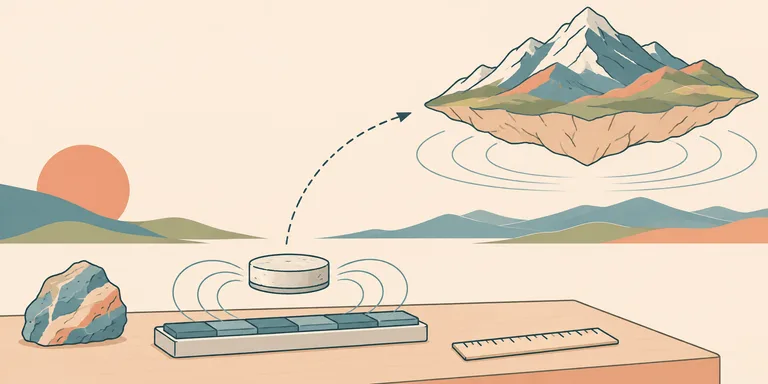
A small superconducting object can hover above a magnetic track. Scaling that demonstration into one of Avatar's floating mountains requires more than making the object larger. The supporting field, the material response, and the stability of the whole arrangement have to scale too.
That is the part of the scene I find interesting. Magnetic levitation is real, so the first step towards the fictional explanation sounds plausible. A rough calculation shows how much the next steps demand.
I would treat the calculation as a way to expose assumptions, not as a design for a mountain. Ordinary rock cannot be assigned the behaviour of a laboratory superconductor because both appear in a sentence about magnetism.
The tabletop demonstration has a prepared material
The University of Iowa's flux-pinning demonstration uses a superconductor and a magnetic track. In a suitable type-II superconductor, pinned magnetic flux can provide restoring forces that help keep the object in position relative to the track.
That is more specific than saying superconductors simply push every magnetic field away. The response depends on the material, temperature, field, and preparation. The track is also an engineered source of the field, not a convenient patch of ordinary ground.
A rock's response depends on its composition. Some materials are diamagnetic; others respond differently. Neither a striking demonstration nor the word magnetic establishes that a cliff has the required response. The material model must be stated before calculating its support.
Give the rock a weight per square metre
For an illustrative estimate, take a slab 1,000 metres thick with density 2,700 kilograms per cubic metre. Use Earth's gravitational acceleration of 9.81 metres per second squared. Its weight divided by its footprint is density times gravity times thickness: about 26.5 million pascals, or 26.5 MPa.
These are chosen assumptions, not measurements of a fictional mountain. A thinner slab, different density, or different gravity changes the result. The footprint cancels in this simplified comparison because both the total weight and the hypothetical supporting area grow together.
Now compare that load with a magnetic stress scale. The expression B squared divided by twice the vacuum permeability appears in the description of magnetic pressure. At one tesla, that scale is about 0.40 MPa.
Equating it to the illustrative slab's load gives roughly 8.2 tesla. This assumes an idealised arrangement in which the relevant magnetic stress can act as support across the footprint. It does not mean an ordinary rock placed in an 8.2-tesla field will levitate.
For that, the interaction with the material and the spatial variation of the field have to produce the required upward force. Stability against sideways movement and rotation also needs an explanation. A pressure scale alone cannot supply one.
A planet's field is a different scale
NOAA's geomagnetic explanation gives approximate surface field strengths of 30,000 nanoteslas near the equator and 60,000 near the poles. Those are 30 to 60 microteslas. The illustrative 8.2-tesla scale is more than a hundred thousand times larger.
That comparison concerns field strength, not an exact force ratio on every possible material. Force also depends on how the object couples to the field and how the field changes with position. It is enough to show why Earth's ordinary background field cannot be substituted for the engineered track in the tabletop demonstration.
A fictional planet can have fictional materials and conditions. To make its explanation physically testable, it would need to specify them. A floating cliff is not evidence for a stable support mechanism just because magnetic fields can exert real forces elsewhere.
Ambient pressure is not room temperature
The material question also needs current terminology. A November 2026 Argonne research account describes pressure-quenching experiments that preserved superconductivity in Hg1223 at ambient pressure, with a transition temperature of 151 K. That is approximately minus 122 degrees Celsius.
Ambient pressure describes the pressure during the measurement. It does not mean the sample works at an ordinary room temperature, or that no high-pressure preparation was required. Nor does a transition-temperature result establish a material's ability to support a geological load in a huge field.
For an exhibit, I would put the real levitation demonstration beside the assumptions in the slab calculation. Visitors could change thickness or density and see the required stress rise. The hover would remain impressive. The numbers would explain why the same word, levitation, covers a working laboratory arrangement and a mountain whose supporting machinery the story has yet to specify.