Life 2.8 kilometres underground runs on a different energy budget
Microbes live in deep fracture water and lake sediments. Their survival depends on local chemistry, while proving what they actually do requires more than finding their DNA.
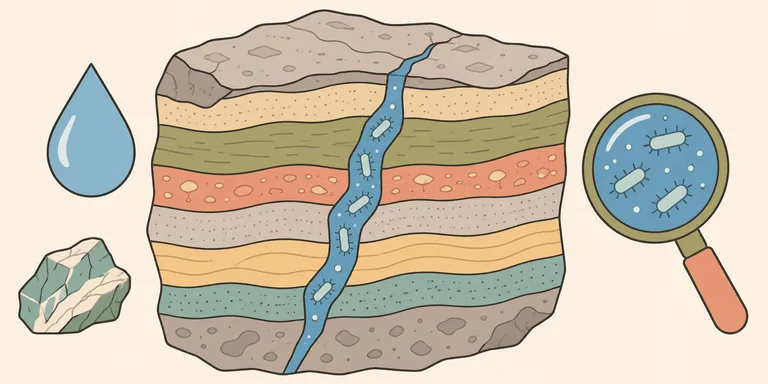
Water collected 2.8 kilometres below the surface in a South African gold mine contained a microbial community dominated by one bacterium. Researchers assembled its genome from that sample. The result made life deep inside continental rock a concrete biological observation, with a particular habitat to examine.
The 2008 study reported that the bacterium accounted for more than 99.9 percent of the microorganisms in the fluid from that particular fracture. That percentage describes the sampled fluid. Communities in other fractures require their own sampling. The original study explains the finding.
Find a chemical source of energy
A cell living in a dark fracture cannot photosynthesize there. Its energy must come through reactions available in that environment. Water moving through rock can carry dissolved substances that microbes use. Some of those substances originate in reactions involving minerals. The useful question is which reactions can supply enough energy under the local conditions.
Desulforudis audaxviator, the bacterium in the South African study, can use hydrogen while reducing sulfate. Radiation from naturally occurring elements can split water molecules, a process called radiolysis. The resulting chemistry can help supply a microbial energy source. The cell still needs the other materials required to build and repair itself; radiation is part of a chemical supply chain. A later single-cell study describes this metabolic context.
Older papers use the provisional name Candidatus Desulforudis audaxviator. The species now has a validly published name under the bacterial nomenclature code. The current LPSN record records the 2026 naming work. The change in naming status does not change where the original sample was collected.
The word underground describes a location. It leaves the energy supply unspecified. A fluid that brings fresh reactants into a fracture creates different conditions from an isolated pocket whose accessible reactants are being consumed. Explaining a community requires understanding the water passing through its habitat.
Lake sediments have their own chemistry
Lake Baikal adds another kind of dark microbial habitat. Sediment below a lake is a separate setting from a fracture deep beneath dry land. The water column above the sediment contributes to the total distance below the lake surface, but it is not the thickness of rock penetrated by a sample.
Some microbes in oxygen-depleted sediment consume methane through anaerobic oxidation. That process requires a suitable electron acceptor, the substance receiving electrons in the reaction. The acceptor available at a particular depth affects which reactions can proceed. A label such as methane-eating microbe leaves much of that explanation unfinished.
A 2023 investigation of iron- and manganese-bearing Baikal sediments examined community DNA, including reconstructed genomes. It found genes indicating several possible chemical pathways, with community composition changing through the sediment. The paper discusses the potential for methane-related metabolism alongside transformations involving nitrogen and metals. The primary study describes the sampled sites and its genomic evidence.
A 2026 Baikal study examined geochemical conditions that could support methane oxidation in different sediment zones. Its description distinguishes the potential for a reaction from the organisms and rates needed to explain what happens in place. The geochemical study is useful for that distinction. The chemistry of a whole lake cannot be reduced to one reaction copied from one sediment layer.
Separate possible metabolism from demonstrated activity
A DNA sequence can identify a lineage or reveal a gene involved in a particular reaction. That is evidence about the organisms present and what they may be equipped to do. Establishing an activity rate requires a measurement directed at that activity. The questions have different experimental requirements.
An incubation can test whether a sampled community consumes a supplied substrate under controlled conditions. An isotope experiment can track material through a reaction. The interpretation then has to account for how collection and incubation changed the environment. A result under laboratory conditions needs that context before it describes the undisturbed fracture.
Repeated sampling supplies another part of the explanation. A 2026 study at the Deep Mine Microbial Observatory in South Dakota followed communities over four years. Samples came from fluids at several underground sites. Communities differed strongly between sites, even though a site's community could remain relatively consistent across time. The DeMMO study links those observations to local geochemistry.
The South African fracture contained an unusually low-diversity community. DeMMO documented variation across sites. Sampling another borehole can mean sampling another water supply with different chemical conditions.
Depth alone cannot predict survival
Pore space determines where a cell can physically fit. The accessible reactants determine which reactions it can sustain. A chemically favorable reaction may contribute little to life if the needed reactants rarely arrive. Establishing the actual supply is part of establishing what the habitat can support.
The same restraint applies to lifespan claims. Detecting an organism deep underground gives no direct measurement of the age of that individual cell. A history reconstructed for the surrounding water describes that water. Determining how long cells persist or how often they divide requires additional evidence.
Deep microbial life changes the conditions worth investigating beneath a surface. A useful next question is specific: which chemical reaction supplies this sampled community, at what rate, under the conditions measured here?