An eleven-kilometre dive record does not describe the whole expedition
Read China's deep-ocean progress through dated mission records, depth-specific dive counts and the work each vehicle performs.
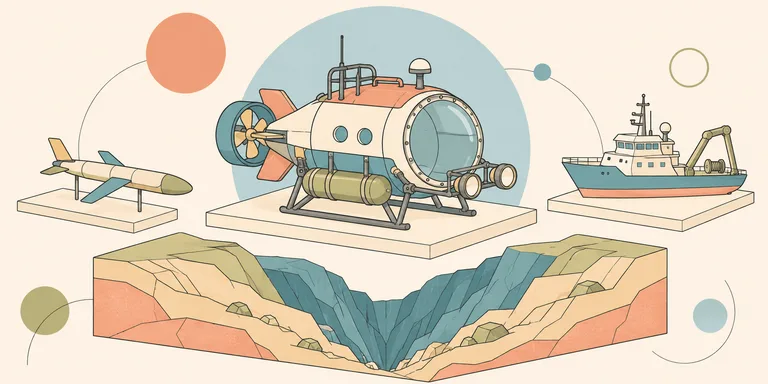
Fendouzhe reached a reported depth of 10,909 metres in the Mariana Trench in 2020. That establishes a depth capability. It does not tell us how often the submersible can return, how much useful sampling it can complete or how many of its later dives reached the same depth.
China's deep-ocean programme is more interesting when those questions stay separate. Recent expeditions provide evidence of repeated operations. Their dive counts still need to be read at the depths and dates actually reported.
Count the dives at their reported depth
The Chinese Academy of Sciences' account of Fendouzhe's development records its 2020 sea trials and 10,909-metre dive. That is an institutional account of the vehicle's demonstrated maximum.
A May 2026 report on the China-Chile expedition describes 63 dives, with 50 exceeding 6,000 metres. Those figures show repeated deep operations during that mission. They do not mean 63 dives at eleven kilometres.
An earlier 2022 operations report makes the distinction explicit: Fendouzhe completed 75 dives that year, including four at the 10,000-metre level. Depth-specific counts prevent a record-setting vehicle's entire workload from being described as full-ocean-depth work.
The reporting source also needs to remain visible. These are published institutional or institute-attributed tallies. They provide dated evidence, with less detail than a complete independently audited mission dataset would offer.
Different vehicles answer different questions
A crewed submersible carries researchers to a site. A glider profiles the water column using a different operating pattern. Comparing their maximum depths alone obscures what the instruments were built to measure.
The academy's account of the Haiyi glider mission reports a 6,329-metre dive and repeated profiles during a four-day deployment. That is evidence for the described glider and mission. It cannot be extended to every model carrying a similar translated name.
A glider's broad water-column observations can complement a submersible's close inspection. The datasets still need compatible positions and timestamps before researchers can connect them. More platforms create more opportunities to observe, along with more work reconciling what each measured.
Uncrewed vehicles can also be designed for intervention or surveying. Check the specific vehicle's manipulator, navigation system and mission record before assigning it a role. The label "robot" supplies almost none of that detail.
The ship remains part of the system
A submersible's specification does not include every condition needed for a useful expedition. Launch and recovery depend on the support vessel and operating conditions. Samples need handling after they reach the deck.
That makes repeated missions a systems question. The useful unit of performance may be a completed sampling programme, with location records and usable material, instead of a single impressive descent.
A 2025 Arctic expedition account reports 43 Fendouzhe dives over a 98-day voyage. The same account describes coordination with Jiaolong. It supplies a concrete example of campaign-level operations without establishing a general turnaround time for every sea state.
If you are comparing future programmes, ask what the dive count includes. An attempted descent and a completed science dive should be distinguishable. So should time underwater and time spent on the target task.
Communication limits shape the plan
Underwater communication also changes the work. Woods Hole's Alvin systems description distinguishes its underwater acoustic telephone from the VHF radio used at the surface. The vehicle's connection to the ship has different properties from a laptop's connection to a network.
Acoustic messages can support coordination and status reporting. They do not imply an unrestricted high-bandwidth video link at any distance. Mission planning must account for what information can actually move through the available channel.
Long-term docking and recharging could change some operating constraints. A demonstrated docking trial would still need to be distinguished from a deployed year-round service. A plan for persistence is evidence of an engineering goal until operating results establish more.
The next useful claim about deep-ocean capability should therefore name a mission and an outcome. "Fifty dives deeper than six kilometres on this expedition" gives a reader something to examine. "We routinely work at eleven kilometres" needs depth-specific records that support that exact statement.