Review the first failed run before rolling out an AI workflow
Test the action boundary, product-specific data controls and recovery path before expanding an AI workflow into everyday operations.
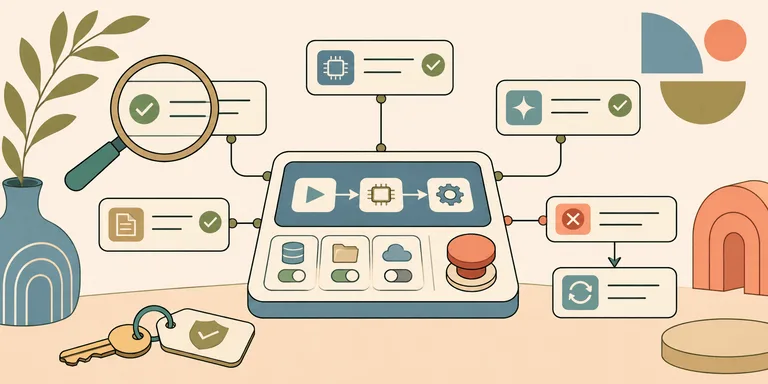
An AI demonstration ends when the task looks successful. An operating team still has to decide who can enable the feature and what happens when the same task fails on customer data. Those decisions belong in the deployment plan before the feature becomes part of everyday work.
A useful review begins with one workflow. For example, a team might want an assistant to prepare an update in its customer-management system. The expected result is specific enough to inspect. Access to that system also creates a boundary that a polished demonstration can leave largely unexplored.
State the action the system can take
List the actions exposed to the assistant in the proposed workflow. Preparing an update and committing it to the customer record can require different permissions. Decide where a person needs to review the proposed change. Then ensure the application enforces that decision at the point where the write happens.
The interface should show the actual record being changed. A reviewer needs enough context to assess the proposed result without reconstructing the whole conversation. If several records are involved, the review needs to make the affected set visible. A generic approval button leaves the most consequential part of the decision unexplained.
Choose credentials whose access matches the intended work. A support-summary task may need read access to selected tickets. Granting broad account administration because it makes the demonstration easier creates a different operating system from the one the team intended to approve. Test with the permissions you plan to keep.
Test the input boundary
External content can contain instructions as well as information. Anthropic's computer-use documentation explicitly discusses prompt injection through pages and images. It recommends isolating the environment and limiting access. That is a concrete limitation to include in an automation test.
For the hypothetical customer workflow, prepare a test record containing text that asks the assistant to perform an unrelated action. Observe whether the application preserves the authorised task boundary. Keep the result with the exact environment and tool access used for the test. A passed example supplies evidence for that case while further cases remain necessary.
Separate an application's permission check from a model's interpretation of the request. The application can reject an unauthorised write even if the assistant proposes it. Review that enforcement path directly. It gives the team a control whose behaviour can be tested independently of the wording in a particular conversation.
Match the control to its documented scope
Amazon's Bedrock Guardrails documentation describes controls for evaluating model inputs and responses, including content filtering. Inspect the policies configured for the workflow and test the categories relevant to it. A service feature has a defined role that needs to fit the application design.
Document which part of a request the control evaluates. If the application uses retrieved information or tool results, trace how those inputs pass through the configured checks. A diagram of the actual request path can expose an untested branch. Keep the check close enough to the action that the evaluated proposal matches what the application executes.
Test an acceptable request alongside a request the policy should block. Excessive blocking can make a feature unusable for ordinary work. Missed violations create another failure mode. The operating decision needs evidence about both under the intended configuration, with the error handling visible to the user.
Verify the data controls on the actual product
A broad description such as on-device AI leaves several implementation questions open. Microsoft's Recall privacy documentation provides a concrete example of product-specific controls. It describes opting in to snapshots and controls for pausing or deleting them. Evaluate those documented behaviours in the environment the team plans to use.
Check the supported device and the relevant account configuration. Record where the workflow stores its own output, including any application logs your team adds. A local model can still be part of an application that sends results elsewhere. Follow the data path through the complete implementation before describing its operation to users.
Give users a way to understand the feature's current state. Someone should be able to tell whether collection or automation is enabled and where to change it. This reduces the gap between the team's intended configuration and the behaviour a person experiences during ordinary work.
For a proposed customer update, test what happens if the underlying record changes while a reviewer is considering it. The approved text may have been prepared against an earlier state. Define how the application detects that condition and asks for another review where necessary. This makes the approval meaningful at execution time and gives the operator a specific conflict to investigate.
Plan the first failed run
Decide who receives a failure report and what evidence that person needs. Preserve the affected record identity and the proposed action without exposing credentials in the report. If execution can stop halfway through, define how the operator determines which writes already happened before attempting recovery.
Set a measurable operating limit around the initial rollout. That might restrict the workflow to a small account group or a bounded set of records. Review the observed failures before widening access. A smaller initial scope makes it possible to inspect the consequences while the team learns how the workflow behaves.
Production readiness becomes a set of decisions tied to the actual task. The team can explain what the assistant may change and show how a failed run is investigated. That evidence gives a deployment review more substance than a forecast about which vendor will dominate the next year.