A burned scroll became readable without being opened
Reading PHerc. 1667 required an X-ray scan to become a reconstructed surface before scholars could inspect the writing. Each stage leaves evidence that can be questioned.
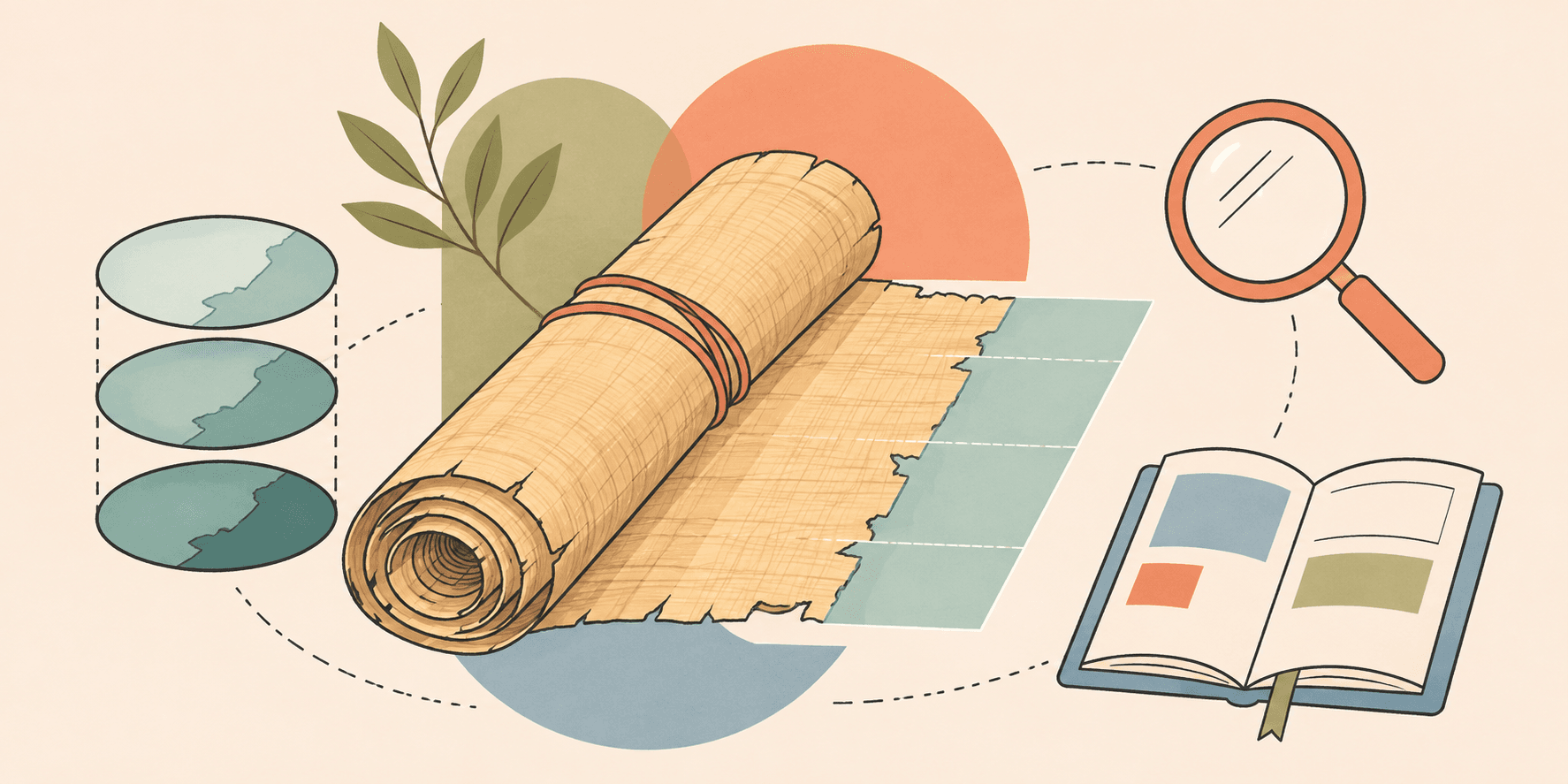
A burned papyrus roll can survive almost two thousand years while remaining too fragile to open.
Researchers have recovered writing from a roll in that condition without physically opening it. On June 25, 2026, the Vesuvius Challenge announced continuous reading of the preserved text of PHerc. 1667, extending earlier results from isolated words or small patches. The 2026 scroll announcement
My old note described AI reading forgotten languages. The Herculaneum problem was access to writing inside damaged material. Scholars could read the Greek once enough of the writing became visible.
Reconstruct the writing surface
A closed scroll contains tightly packed layers. Photography shows its exterior, while the writing can lie on a compressed sheet deep inside. Bends or damage complicate locating that sheet in three dimensions.
High-resolution X-ray scans capture the internal structure. Computational methods identify the papyrus surface before flattening it into an inspectable image. Machine learning helps detect the ink signal, leaving specialists to examine the recovered writing.
The June 2026 preprint describes complete virtual unwrapping with explicit coverage criteria. It also specifies scholarly review of the reading. That publication makes the method available for scrutiny, with its preprint status attached to the result reported there. The virtual-unwrapping preprint
ESRF, a partner in the project, describes its high-resolution scanning work on the same scroll. Its account covers the recovery of substantial new text. Reading that text required the imaging work to connect through the software to scholars interpreting the material. ESRF's account of the discovery
Locate ink in the scan
Carbon-based ink can have nearly the same density as carbonized papyrus. The Vesuvius Challenge tutorial explains how infrared photography can show writing on a detached fragment while its ink becomes difficult to distinguish in an X-ray scan. Ink-detection tutorial, updated September 2026
The detector works on that physical signal after the writing surface has been reconstructed. Its task is to find evidence of ink within the scan.
A reconstruction error can put the detector on the wrong material. A detected signal then needs examination to determine whether it supports a reading. Uncertainty at either stage can remain even when the final image looks smooth.
I'd keep those stages linked in a software interface. A proposed character should open onto its image, with the reconstructed surface traceable to the relevant scan region. A reviewer could then investigate where a disputed reading originated.
Label proposed restorations
Ink detection asks where a mark may be present. Restoring an inscription proposes text for a gap. Translation expresses known-language text in another language, while decipherment investigates a writing system whose meaning is unresolved. Each task needs evidence appropriate to its question.
Google DeepMind introduced Aeneas in July 2025 for work on ancient Latin inscriptions. It retrieves parallels that can help assess historical context, with restoration suggestions for missing text. Its inputs give it a different task from finding ink inside a closed scroll. The Aeneas research announcement
A proposed restoration can fit the context after the physical letters have disappeared. An ink-based reading instead needs marks that support the proposed letters. The output should state which evidence supports each passage.
I'd carry those labels into exported transcriptions too. A reader should be able to distinguish visible evidence from a proposed restoration, with unresolved text marked accordingly. Each project's actual presentation would need inspection against that requirement.
Make a disputed reading traceable
The Vesuvius Challenge announcement provides data with code. Recovered surfaces accompany the scholarly work. Those materials let others investigate the process behind the reading.
A reproducible output needs its scan identified. The reconstructed surface needs a version, with the model and processing settings recorded. Keep the earlier reading when a correction is made. Collaborators also need a stable reference to the location under discussion.
A developer can improve that inspection process without deciding which letter a faint mark denotes. The interface needs to support the scholar's judgment, leaving its evidence available for another person to examine.
Evaluate the next scroll on its own evidence
Continuous reading of one scroll establishes a result for that artifact. Another roll may have different geometry or damage. Its ink visibility can also differ, so recoverable coverage needs to be evaluated again.
The sequence explains what the result required. The scan supplied measurements for reconstruction; the reconstructed surface then supplied evidence for scholarly reading. A failure at any step would affect what the next step could establish.
This method gives scholars access to writing while leaving the fragile roll physically closed. Its evidence can remain available for questions after the first reading.