AI music uploads and AI music listening are different counts
Catalogue acceptance, recommendations, genuine plays, and royalty eligibility are separate boundaries. Current platform reports show substantial supply alongside filtering.
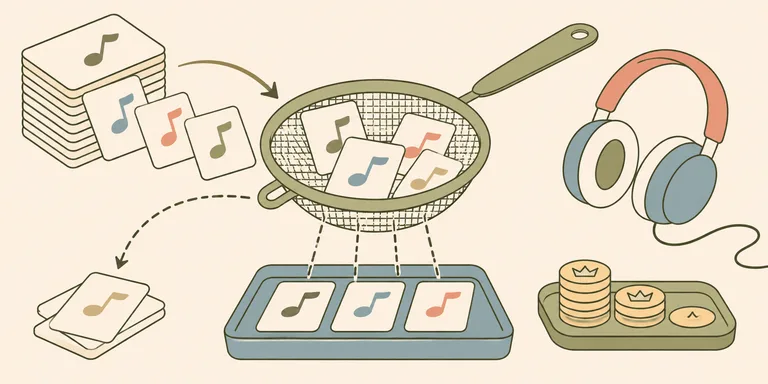
The number of songs uploaded to a streaming service does not tell you what listeners hear. Upload acceptance, recommendation, actual listening, and royalty eligibility are separate decisions. A large supply can coexist with a much smaller share of plays.
That distinction gives a better account of AI-generated music than the idea that streaming platforms have simply locked the gates. Their own recent reports describe substantial incoming volume alongside filtering and enforcement. The controls reduce some exposure; they do not establish that every unsuitable track is stopped.
Separate upload supply from listening
In its October 2026 detection update, Deezer reported roughly 90,000 fully AI-generated tracks arriving daily and said it had removed more than 42 million detected tracks from algorithmic and editorial recommendations between January 2025 and August 2026. These are the company's reported figures for its own service and detection process.
They do not measure all music platforms or all AI-assisted production. A track using one generated element may differ from what a detector classifies as fully generated. Keep that definition attached to the count.
Recommendation exclusion also differs from catalogue removal. A track may remain available through another route while no longer receiving algorithmic distribution. A statement that it was "removed" needs to say which surface or capability changed.
Read platform enforcement as a reported process
Spotify's 20 October 2026 update says it removed more than 50 million slop and spam tracks from recommendations during the year, alongside more than 75 million tracks removed from the platform for serious or repeated rule violations. Those categories should not be added as if they were disjoint totals without further evidence.
Spotify describes combining listener behaviour, upload patterns, metadata, and third-party detection signals. It also acknowledges limitations in AI detection. A policy announcement is therefore evidence of the described approach, not proof of perfect classification or a guarantee about an individual listener's playlist.
The distinction also protects legitimate creators. A mistaken classification and deliberate abuse require different responses. Distribution records, source permissions, and a documented production history can help a creator explain a release without claiming that provenance alone establishes compliance with every rule.
Royalty eligibility is another boundary
Spotify's current track-monetisation guidance requires at least 1,000 streams in the preceding twelve months for inclusion in the recorded-music royalty-pool calculation, plus an undisclosed minimum number of unique listeners. It warns that a dashboard stream count is an estimate of eligibility, not a guarantee.
That threshold does not mean the first thousand stream events are all paid retroactively, nor does it establish a fixed rate per stream. Eligibility and the subsequent royalty calculation need separate explanation. The label or distributor's royalty report remains the relevant record for a creator's actual receipts.
Generating more recordings cannot remove those conditions. Each recording needs a real route to listeners, while the catalogue still requires accurate metadata, permissions, and administration. File count is a poor substitute for demand.
Artificial listening is different from synthetic production
The current Spotify artificial-streaming guidance addresses plays that do not reflect genuine listening intent. It warns against paid services guaranteeing streams or playlist placement and describes possible withholding of royalties and corrections to metrics.
A human-recorded song can receive artificial streams. A generated song can receive genuine listening. Conflating those cases makes it harder to describe what a platform is enforcing and why a payment changed.
For a legitimate release, avoid promises of guaranteed plays. Keep the distributor's communications and investigate unusual activity through the supported reporting route. Do not treat a sudden dashboard spike as proof of a durable audience or a future payout.
The listener's experience comes from several stages after generation: catalogue checks, recommendation decisions, genuine attention, and ongoing enforcement. Current reports show those stages doing substantial work while leaving errors and evasion possible. The honest claim is narrower than saying the gates are locked: upload volume alone cannot explain discovery or earnings.