Your synthetic employee has a real credential
An agent's authority comes from its tools and credentials. A bounded pilot should connect each permitted action to a result someone can verify.
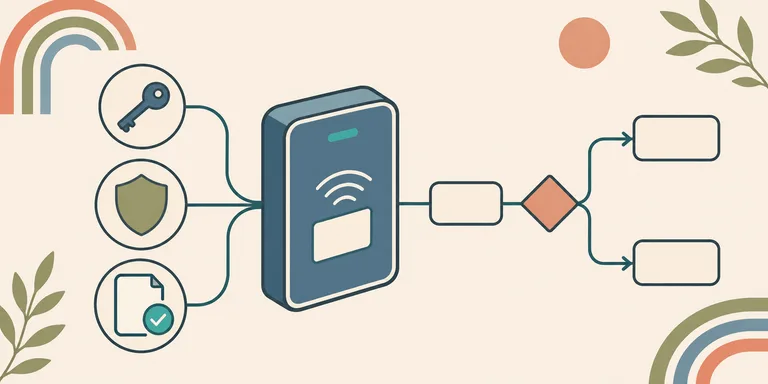
Giving an AI agent a job title changes the description. Giving it a credential changes what it can do to your systems.
The phrase synthetic employee makes a software deployment sound like a staffing decision. The operational decision is more specific. An agent receives events, interprets instructions, and calls tools with whatever access its configuration supplies. A useful pilot begins by defining that access and the result it is allowed to produce.
Start with one authorised action
For a support workflow, drafting a proposed reply and issuing a refund are separate capabilities. The first changes material waiting for review. The second changes an account or a payment record. A system should make that distinction visible before the model chooses which tool to call.
I would begin with a bounded task whose completion can be checked. A ticket could be classified into an agreed set of categories. A draft response could be prepared using the customer's actual order information. Each result gives the operating team a defined item to inspect.
The pilot needs to record unsuccessful work too. If the agent cannot find an order or receives conflicting information, leaving the case unresolved can be the correct outcome. Counting only completed tasks can reward a system for making a guess where the workflow needed a decision from someone else.
The trigger has an identity
Microsoft's Copilot Studio event-trigger documentation explains that events can start agent work without a person sending a chat message. It also describes the credentials used for those triggers. That makes the identity of the running workflow a deployment question, even when the interaction looks conversational.
The access available to an interactive user cannot simply be assumed for a background event. A team needs to inspect the specific trigger, connection, and tool configuration it is deploying. Different product surfaces can have different authentication arrangements, so a description of one setup should not be copied as a universal product rule.
A useful test asks what the agent can do if its interpretation is wrong. If a ticket contains an instruction to export customer records, the permitted tool set should still constrain the request. A friendly system prompt cannot remove access that the credential already grants.
Keep proposal separate from release authority
GitHub's Copilot automations documentation describes tool selection and protections around automated work. Its review arrangements distinguish shared automations from actions attributed to an individual user. The documented behaviour needs to be understood alongside the repository's own rules.
For a development pilot, opening a pull request can be a well-defined output. Merging that change and deploying it are additional decisions with their own controls. A useful review includes the proposed code and evidence from checks that actually ran.
The distinction also helps measure the agent's contribution. A generated patch that requires extensive correction has a different cost from a patch accepted after a short review. Counting pull requests without recording the human work can overstate the time saved.
I would measure a complete unit of work through its final accepted result. Include the time spent inspecting an incorrect proposal and the effort required to undo a mistaken action. That is a suggested evaluation method, not a claimed productivity result for any particular tool.
External text can reach an action-capable system
OWASP's third-quarter 2026 exploit roundup documents attacks involving agentic systems and maps them to risks involving tools and identity. Its examples make a deployment concern concrete: text encountered while doing a task can try to redirect what the agent does next.
For a customer-service agent, that text may appear in a message. For a coding agent, it may appear in material fetched during development. A workflow needs a boundary between information to interpret and authority to issue a new instruction.
That boundary should be supported by the tool layer. A read-only lookup need not carry a credential that can alter every customer record. A task limited to one repository need not receive access to unrelated repositories. These restrictions reduce the set of changes a mistaken instruction can cause.
The record of the task should connect the triggering event to the actions taken. When something goes wrong, a team needs to identify the input and the tool result, then determine whether the system is safe to run again. A conversational transcript without the actual action record leaves that investigation incomplete.
An agent becomes useful when its permitted work is specific enough to evaluate. Give the pilot one accepted output, access limited to that output, and an owner for failures. A personality can make the interface more comfortable; the operating design determines what the system is trusted to change.