A jet suit needs a maneuver it can finish
A record speed leaves the next turn to be tested. A complete jet-suit specification needs the forces and configuration required for the maneuver.
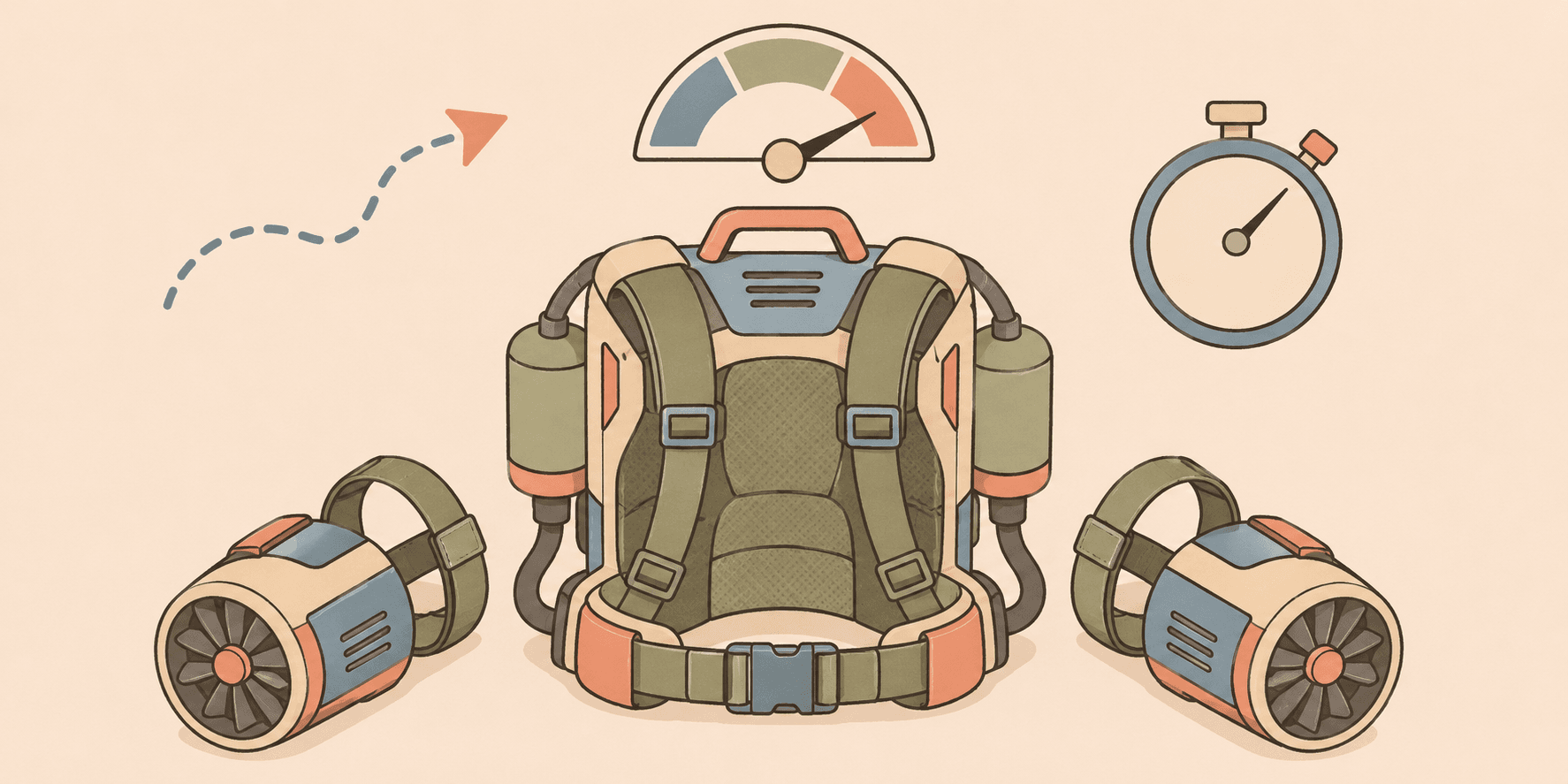
A jet suit can lift its pilot while leaving the movie's next maneuver out of reach. Turning requires force, with the load carried through whatever connects the engines to the person.
That connection is where I'd begin an engineering assessment of an Iron Man-style suit. More engine output changes what the machine can generate. The complete design still needs to transfer that force through a structure while controlling where it points.
The question therefore needs an intended maneuver. Hovering above a landing area gives the equipment one job. Turning sharply at speed gives it another, even if both appear in the same short demonstration.
Keep the current specification with its date
Gravity Industries' professional page, checked in November 2026, lists roughly three minutes of flight time with a 60 mph top speed. It describes control through human-vectored thrust. These are manufacturer specifications for the offering described on that page. Gravity's professional specifications
The frequently repeated 85 mph figure has a different origin. Guinness records Richard Browning reaching 85.06 mph at Brighton Beach on November 14, 2019. That is a dated speed-record result, with a specific attempt behind it. The Guinness record
Combining the record speed with a flight-time figure from another version would create a capability that neither source has demonstrated. A proposed journey needs evidence for the same configuration under the conditions in which it would be used.
I'd also want to know what remains in reserve at the quoted limit. A maximum-duration figure leaves the return journey to be accounted for. A top-speed result leaves the stopping distance to be measured.
Hover already consumes supporting force
For a simplified stationary hover, upward thrust balances the combined weight of pilot and equipment. Increasing the net upward force produces upward acceleration. NASA explains the corresponding launch requirement through thrust exceeding vehicle weight. The calculation has to include the mass being carried. NASA's explanation of thrust and weight
Armor added afterward increases that supported weight. If the original configuration had little thrust available beyond hover, the extra mass reduces what remains for acceleration. The same issue applies to fuel or a larger support structure.
A structure can spread a load over the body. Its addition also becomes part of the load the engines must support. The design needs to evaluate both effects together before assigning a benefit to the extra hardware.
The attachment points need their own analysis. A whole-system force tells us how the combined mass accelerates; it leaves the local force on a particular harness or joint unresolved. Calculating that requires the actual geometry through which the force travels.
A faster turn needs more force
For motion around a circle, acceleration toward the center is speed squared divided by radius. Double the speed while retaining the radius, and the required inward acceleration becomes four times larger. OpenStax derives that relationship from circular motion. The centripetal-force calculation
Take an illustrative 100-kilogram combined mass moving at 10 meters per second through a 20-meter-radius turn. The inward acceleration is 5 meters per second squared. That requires 500 newtons of horizontal force. At 20 meters per second on the same radius, the required horizontal force becomes 2,000 newtons.
Those numbers describe a deliberately simplified example. They exclude air resistance, with the vertical supporting force left as a separate requirement. They also supply no measurement of what a person could tolerate. Their purpose is to show how quickly a maneuver changes the load demanded from a design.
An instantaneous right-angle change of velocity would require an unbounded acceleration in this idealization. A real turn needs time over a curved path. The film can omit that path; a flight test must define it.
Tilting the force changes what supports the weight
NASA's banking-turn explanation separates a supporting force into vertical and horizontal components. The vertical component opposes weight while the horizontal component produces the turn. Its example concerns a winged aircraft, whose lift mechanism differs from a jet suit's thrust. NASA's turn explanation
The component accounting still explains the design question. Tilting a fixed-magnitude force gives some of it a sideways direction, reducing its vertical component. Maintaining altitude during that maneuver needs sufficient total supporting force for the new direction.
That makes control authority part of the specification. I'd want the test to show which maneuvers remain controllable near the equipment's limits, with the response to a disturbance included. A successful straight flight supplies evidence for the straight flight actually performed.
A report should also state the starting conditions. The carried mass affects the required force, while the chosen speed affects the turn calculation. A result repeated under one set of conditions remains evidence for those conditions. Extending it to another payload needs another assessment. Keeping the configuration identified lets a later reviewer determine whether two demonstrations tested the same machine, instead of treating every clip with a similar-looking backpack as one accumulating specification.
Assess a complete maneuver
My original gist proposed extra stabilization hardware before predicting much longer flights with sustained high loads. That was a speculative concept. It had no validated mass budget or test record behind those performance numbers, so those numbers cannot describe an achievable suit.
A credible proposal would state the maneuver before measuring it with the complete equipment. It would also explain how the operator returns to a stable condition afterward. Starting the turn is only part of that task.
I'd judge the suit against that recorded behavior. Personal flight already exists; the next claim needs the equipment configuration with the path it can actually complete.